
Walk into any gym, and you’ll see a stark contrast. On one side, lifters spend hours isolating individual muscles with “chest day” or “arm day” routines. On the other, a rare few hit every major muscle group in a single, brutal session.
So, who’s got it right? Is it better to dedicate an entire workout to one muscle, or to bombard your entire physique in one go?
If you’re serious about maximizing muscle growth and strength, the answer lies in understanding the biological stimulus and recovery demands of your body. Let’s pit Full Body against Split workouts to see which reigns supreme for optimal results.
The “Biological Trigger” Imperative
Muscle growth is not a cumulative effect of endless sets. It’s a precise biological response to a specific, intense stimulus. Your body doesn’t “know” it’s chest day; it only registers whether a muscle has been worked hard enough to necessitate growth.
- The Goal: The purpose of any workout is to trigger the growth mechanism, then get out of the way and allow the body to recover and grow.
Full Body Workouts: The Case for Efficiency
A full body workout involves hitting every major muscle group in a single session. This approach might seem daunting, but it aligns perfectly with the principle of maximum stimulus and optimal recovery.
The Advantages:
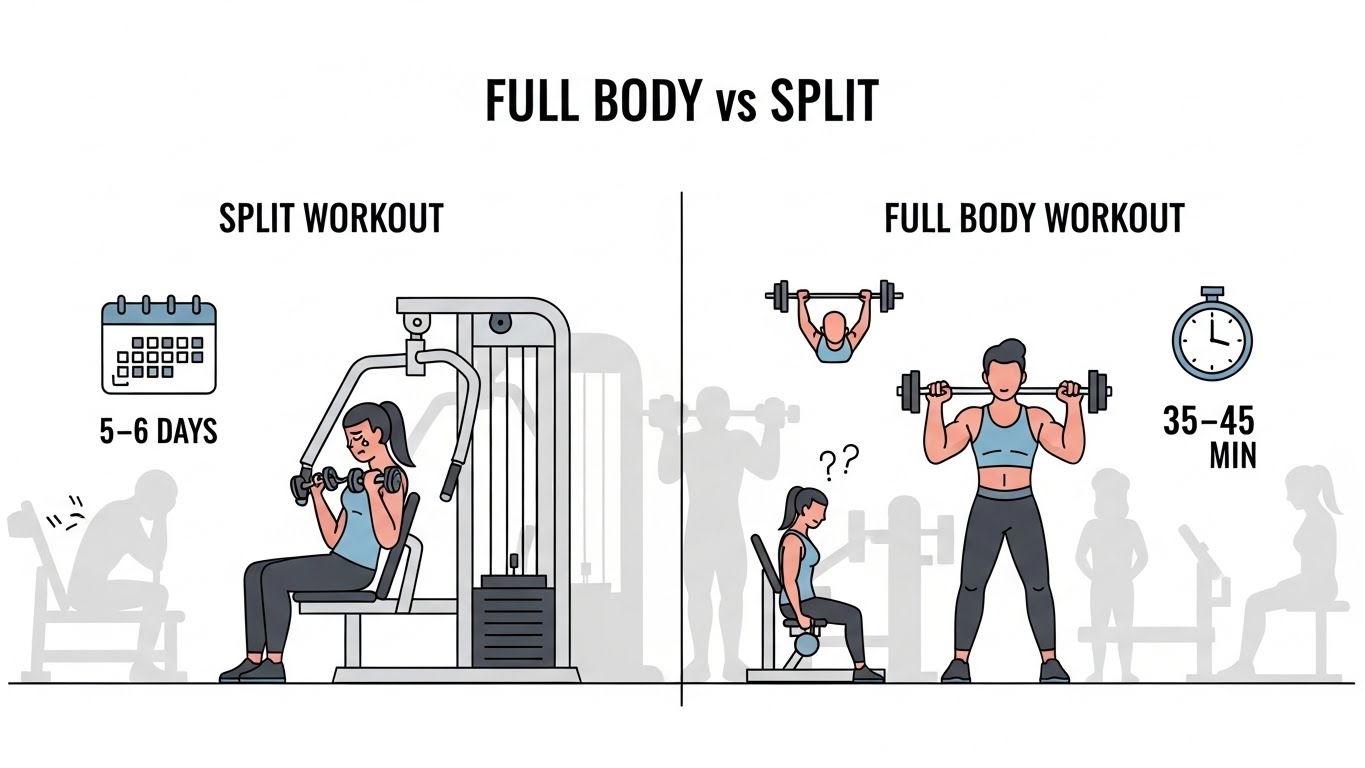
- Superior Recovery: If you train your entire body on Monday, you then have Tuesday, Wednesday, and Thursday to recover before your next session. This often means 48-72 hours of uninterrupted repair time.
- Increased Frequency: While each muscle might only be trained once per session, it’s stimulated more frequently across the week (e.g., 3 times a week vs. once every 7 days for a split). This consistent signaling can be highly effective for growth.
- Hormonal Response: Training multiple large muscle groups (legs, back, chest) in one session tends to elicit a greater acute hormonal response (testosterone, growth hormone), which is beneficial for overall anabolism.
- Time Efficiency: A properly structured full body workout can be completed in 30-45 minutes, allowing you to get in, get the job done, and focus on recovery.
The Drawback:
- Intensity Limitation: If every set is taken to absolute muscular failure, it can be difficult to sustain that level of intensity across many different muscle groups in one go. However, this is largely mitigated by focusing on one hard set per exercise.
Split Workouts: The Case for “Targeted Exhaustion”
Split routines typically divide the body into smaller sections (e.g., Push/Pull/Legs, Upper/Lower, or individual muscle days).
The Advantages:
- Higher Volume per Muscle: You can perform more sets for a specific muscle group within a single session, theoretically leading to more localized fatigue.
- Focused Mind-Muscle Connection: It allows you to dedicate your mental energy to one or two muscle groups, which some find helpful for feeling the contraction.
The Drawbacks:
- Longer Recovery Demands: If you only train chest once a week, and that session pushes you past your maximum recoverable volume, that muscle might not fully recover before the next week’s session.
- Reduced Frequency: A muscle is only stimulated once every 5-7 days. This can be too infrequent for optimal protein synthesis spikes.
- Time Commitment: Often requires more days in the gym to cover all muscle groups adequately.
The Verdict: Which is “Best” for You?
For the vast majority of lifters—especially those who prioritize maximum intensity, efficiency, and full recovery—the Full Body Workout is often the superior choice.
- If you train 2-3 days a week: A full body routine allows you to hit every muscle group multiple times, with ample recovery in between, ensuring that each session provides a powerful growth stimulus.
- If you train 4-5 days a week: A split routine can work, but you must be mindful of your intensity and ensure adequate rest for each muscle group. If every set is taken to true failure, 4-5 days a week will quickly lead to overtraining.
The Golden Rule: Regardless of your choice, the only thing that matters is providing a stimulus intense enough to force adaptation, then allowing your body to fully recover and grow stronger for the next session. If you consistently achieve that, your muscles will have no choice but to respond.
My Final Thoughts…….
Don’t confuse activity with productivity. A well-designed, brief, and intense full body workout, performed 2-3 times a week, often yields better results than endless hours spent on complex split routines. Focus on quality over quantity, and your body will reward you with growth.