
The pushup is the ultimate “anywhere, anytime” exercise. But despite being a staple of gym classes and military drills, it is one of the most poorly executed movements in fitness.
Most people treat pushups as a race—trying to hit a high number of reps while their hips sag, their elbows flare, and their range of motion shrinks. This isn’t just ineffective; it’s a recipe for shoulder impingement.
If you want to turn the pushup into a serious muscle-building tool, you need to stop focusing on how many and start focusing on how. Here is the logic-based guide to the perfect pushup.
1. The “Plank” Foundation
A pushup is simply a moving plank. If your core isn’t engaged, the force doesn’t transfer efficiently, and your lower back takes the brunt of the load.
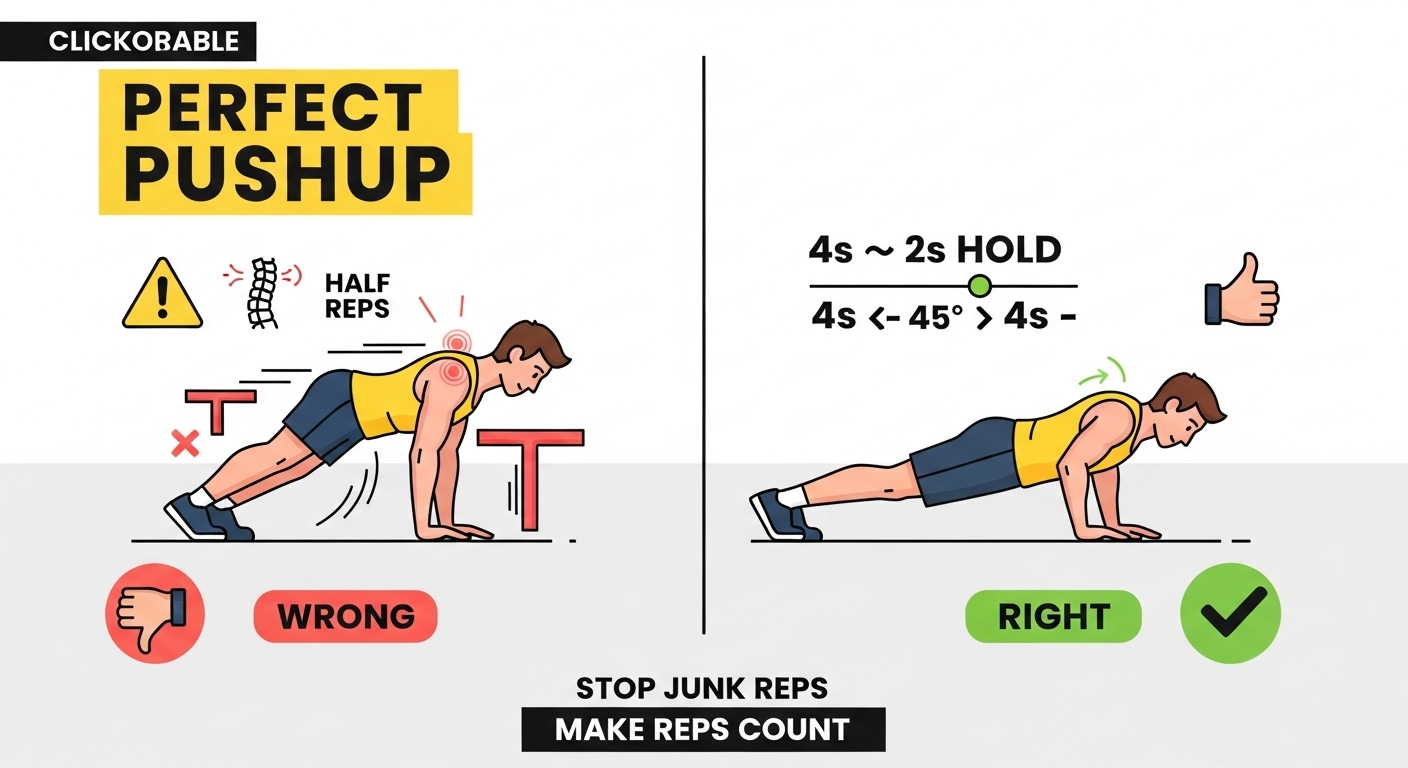
- The Fix: Squeeze your glutes and brace your abs as if someone is about to punch you in the stomach. Your body should form a perfectly straight line from your head to your heels. If your “butt is in the air” or your “hips are dipping,” the rep doesn’t count.
2. Elbow Positioning (The 45-Degree Rule)
The most common mistake is flaring the elbows out at a 90-degree angle (forming a “T” shape). This puts immense pressure on the delicate tissues of the shoulder joint.
- The Fix: Tuck your elbows in toward your ribs at a 45-degree angle. From above, your body should look like an arrowhead, not a capital T. This position prioritizes the chest and triceps while keeping the shoulders in a safe, “packed” position.
3. The Range of Motion (Full Inroad)
In line with our high-intensity principles, a partial rep provides a partial stimulus. To trigger maximum muscle growth, you must work the muscle through its full contractile range.
- The Fix: Lower yourself until your chest is roughly an inch from the floor. On the way up, don’t just stop at “straight arms”—think about pushing the floor away and protracting your shoulder blades at the top. This fully engages the serratus anterior and maximizes the chest contraction.
4. The 4-2-4 Tempo: Eliminating Momentum
If you bounce off the floor, you aren’t using muscle; you’re using “elastic recoil.” To make pushups significantly harder and more effective:
- 4 Seconds Down: Control the eccentric phase. This is where the most muscle damage (and subsequent growth) occurs.
- 2 Seconds Hold: Pause at the bottom. This kills momentum and proves you own the weight.
- 4 Seconds Up: Push with slow, deliberate force.
Common Pushup Mistakes vs. The Correct Way
| Feature | The “Ego” Pushup | The “Simplified” Pushup |
| Tempo | Fast and bouncy | Slow and controlled (4-2-4) |
| Elbows | Flared out (T-shape) | Tucked in (Arrowhead) |
| Core | Sagging or arched | Rigid and braced |
| Range | “Half-reps” | Chest to floor |
How to Progress When They Get Easy
Once you can perform 12–15 perfect, slow-tempo pushups, you have reached the point of diminishing returns. To continue building muscle, you must increase the intensity:
- Elevate Your Feet: Putting your feet on a bench or chair shifts more weight to your upper chest and shoulders.
- Add Resistance: Wear a weighted vest or have a partner place a plate on your upper back.
- Diamond Pushups: Bring your hands together so your index fingers and thumbs touch. This shifts the load heavily onto the triceps.
The Bottom Line
Ten perfect, high-intensity pushups will build more muscle than fifty “junk” reps. Stop counting the reps and start making the reps count. Master the tension, control the tempo, and treat every rep like a masterpiece of biology.