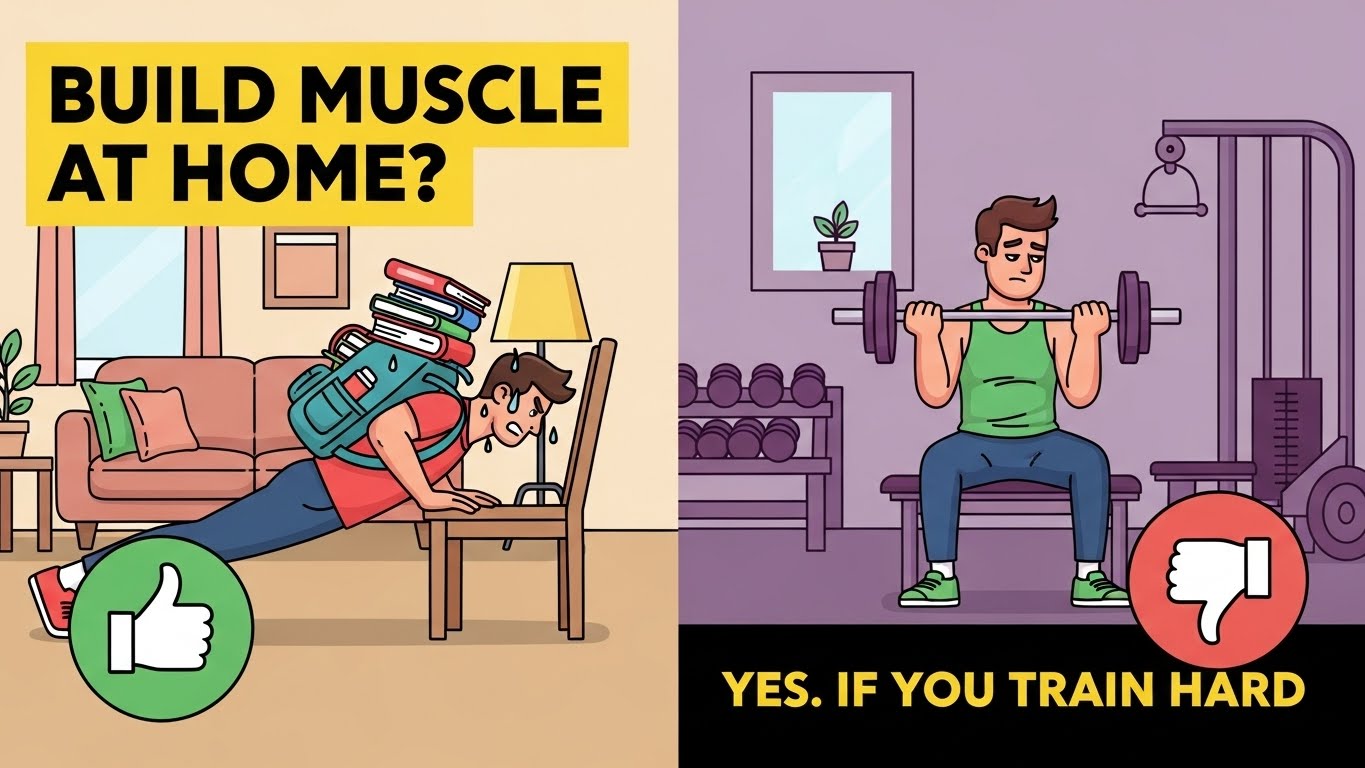

The short answer is yes. Your muscles are blind—they don’t know the difference between a 45lb iron plate and the literal weight of your own body. They only respond to tension.
However, the reason most people fail to build muscle at home is that they treat bodyweight training like “cardio”—doing endless, easy reps until they get bored. If you want to actually grow, you have to stop “exercising” and start training. Here is exactly how to build a gym-quality physique in your living room.
1. The Science of Mechanical Tension
To grow muscle, you must recruit and fatigue “high-threshold” motor units. In a gym, you do this by adding more weight. At home, you do this through Mechanical Advantage.
- The Problem: 50 standard push-ups build endurance, not size.
- The Solution: Make the exercise harder by changing the angle.
- Standard Push-up → Decline Push-up (feet on a chair) → Pike Push-up → Handstand Push-up.
- The Rule: If you can do more than 15–20 reps of an exercise easily, it’s time to find a harder variation.
2. Master the “Tempo” (Time Under Tension)
Since you can’t add external weight, you must increase the time your muscles spend under stress.
- The 3-1-1 Method: Take 3 seconds to lower yourself (eccentric), pause for 1 second at the bottom, and 1 second to explode up.
- This eliminates momentum and forces your muscle fibers to do 100% of the work.
3. Use “Household Resistance”
You don’t need a squat rack to create a load. You just need gravity and a bit of creativity.
- The Backpack Method: Fill a sturdy backpack with books or water jugs. Wear it for lunges, squats, and push-ups.
- Incline/Decline: Use your sofa for split squats or your kitchen counter for tricep dips.
- The Towel Row: Wrap a towel around a sturdy door handle or pole to perform bodyweight rows—the essential “pull” movement for a big back.
4. The Secret to Growth: Training to Failure
In a gym, heavy weights make your muscles fail quickly. At home, you have to be willing to go into the “dark place.”
- Scientific studies show that low-load training (bodyweight) can build as much muscle as high-load training (weights), provided you take the sets to momentary muscular failure. * You must reach the point where you literally cannot complete another rep with good form.
Home vs. Gym: The Muscle Building Comparison
| Feature | Bodyweight Training | Weight Training |
| Cost | Free | Monthly Membership |
| Convenience | 10/10 | 4/10 |
| Ease of Progression | Requires Creativity | Simple (Add plates) |
| Hypertrophy Potential | Equal (if intensity is high) | Equal |
The Essential “At-Home” Muscle Movements
If you master these five movements, you can build a complete physique:
- Push: Decline Push-ups (Chest/Shoulders)
- Pull: Doorway Rows or Pull-ups (Back/Biceps)
- Squat: Bulgarian Split Squats (Quads/Glutes)
- Hinge: Nordic Hamstring Curls or Glute Bridges (Hamstrings)
- Core: Hollow Body Holds (Abs)
The Bottom Line
You don’t need a membership to build a body you’re proud of. You need intensity, consistency, and progressive overload. If you challenge your muscles and eat enough protein, your body has no choice but to grow—whether you’re in a $200-a-month CrossFit box or your own bedroom.