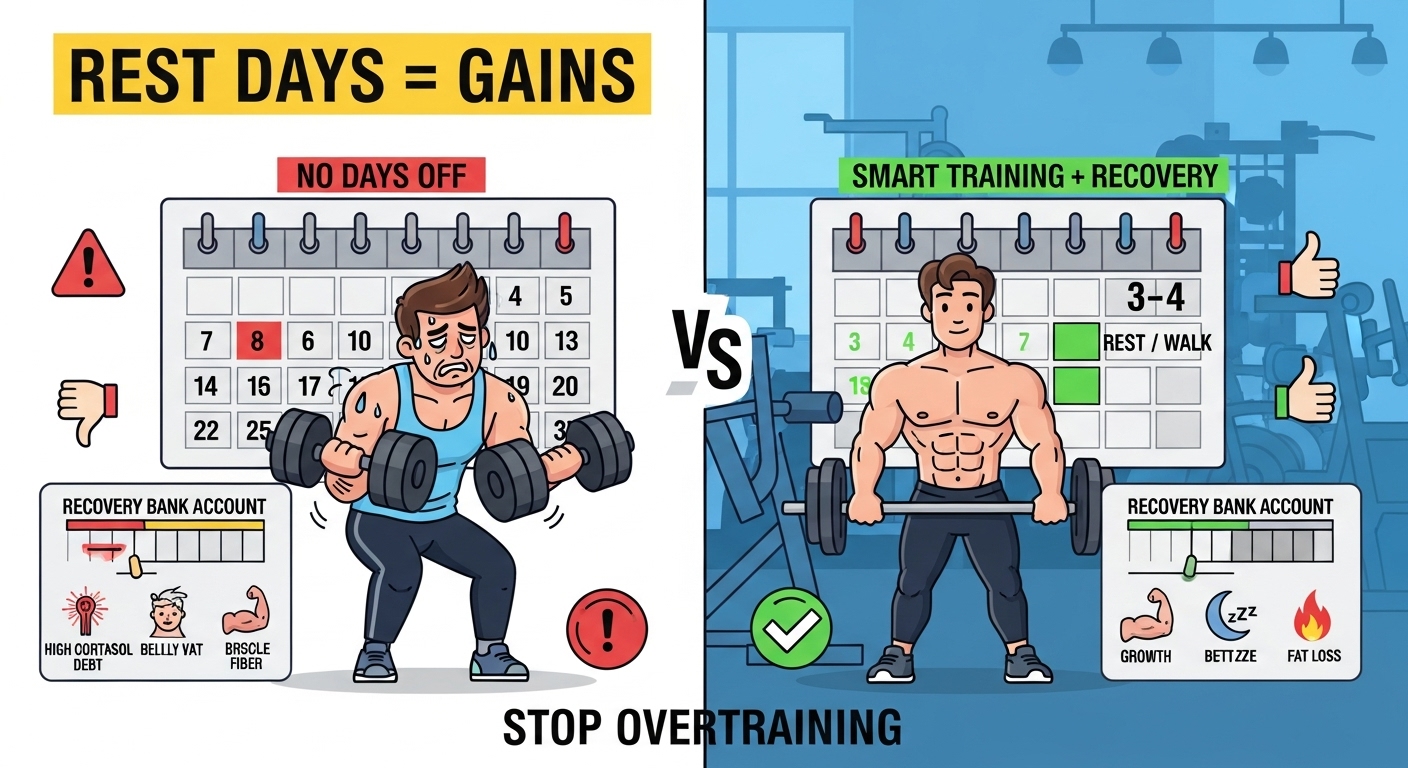

One of the biggest lies in the fitness industry is that you need to live in the gym to see results. We see influencers posting “7-day grind” videos, leading us to believe that if we aren’t training every day, we’re failing.
But here is the biological reality: You do not grow in the gym. You grow while you are resting.
If you want to build a strong, lean physique without burning out or injuring your joints, you need to understand the relationship between intensity and frequency. Here is the logical breakdown of how many days you should actually be training.
1. The “More is Better” Fallacy
Muscle growth is a defensive response to stress. When you train with high intensity, you create an “inroad” into your body’s energy reserves. Your body then needs time to:
- Recover the energy used.
- Repair the tissue damaged.
- Grow new muscle to protect against future stress.
If you go back to the gym before these three steps are complete, you aren’t building muscle—you are simply digging a deeper hole of fatigue. For most people, training every day is the fastest way to stop making progress.
2. The Logic of 3 Days Per Week
For the vast majority of people—from beginners to advanced lifters—three days a week is the “Goldilocks Zone.”
- The Schedule: Monday, Wednesday, Friday (or any day with at least one rest day in between).
- The Why: This allows for 48 hours of recovery between sessions and a full 72 hours over the weekend. This ensures that every time you walk into the gym, you are fully recovered and capable of training with maximum intensity.
3. When Should You Train 4 or 5 Days?
You should only increase your frequency if your intensity is lower.
- The Trade-off: There is an inverse relationship between intensity and duration. You can train hard, or you can train long, but you cannot do both.
- The Split: If you prefer being in the gym more often, you must use a “Split Routine” (e.g., Upper Body/Lower Body). This ensures that while you are training your legs, your upper body is still getting its required 48–72 hours of rest.
Frequency vs. Goals: A Quick Guide
| Your Goal | Recommended Days | Workout Style |
| Maximum Muscle Growth | 3 Days | High-Intensity Full Body |
| General Health/Fat Loss | 3–4 Days | Resistance Training + Walking |
| Athletic Performance | 4–5 Days | Skill-Specific Split |
| Maintenance | 2 Days | Full Body (High Intensity) |
4. The “Recovery” Test: Are You Overtraining?
How do you know if you are training too many days a week? Look for these three red flags:
- Stagnant Strength: If you haven’t been able to add a rep or a pound to your lifts in two weeks, you aren’t recovering.
- Chronic Fatigue: If you feel “wired but tired” or have lost your “spark” for training.
- Lingering Soreness: Muscle soreness should disappear within 48–72 hours. If it lasts longer, your frequency is too high.
5. The “Boring” Truth About Consistency
Consistency beats frequency every single time. It is infinitely better to train 2 days a week, every week, for a year, than it is to train 6 days a week for a month and then quit because you’re exhausted.
Find the lowest number of days that allows you to train with absolute focus and intensity, and stick to it. For most, that number is three.
The Bottom Line
Training is a biological necessity, but recovery is a physiological requirement. Don’t be afraid to take rest days. In the world of high-performance muscle building, less is often more, provided that the “less” you do is performed with 100% effort.
Are you unsure if your current schedule allows for enough recovery? Tell me your current workout routine and how many hours of sleep you get, and I’ll help you optimize your training days for better results!