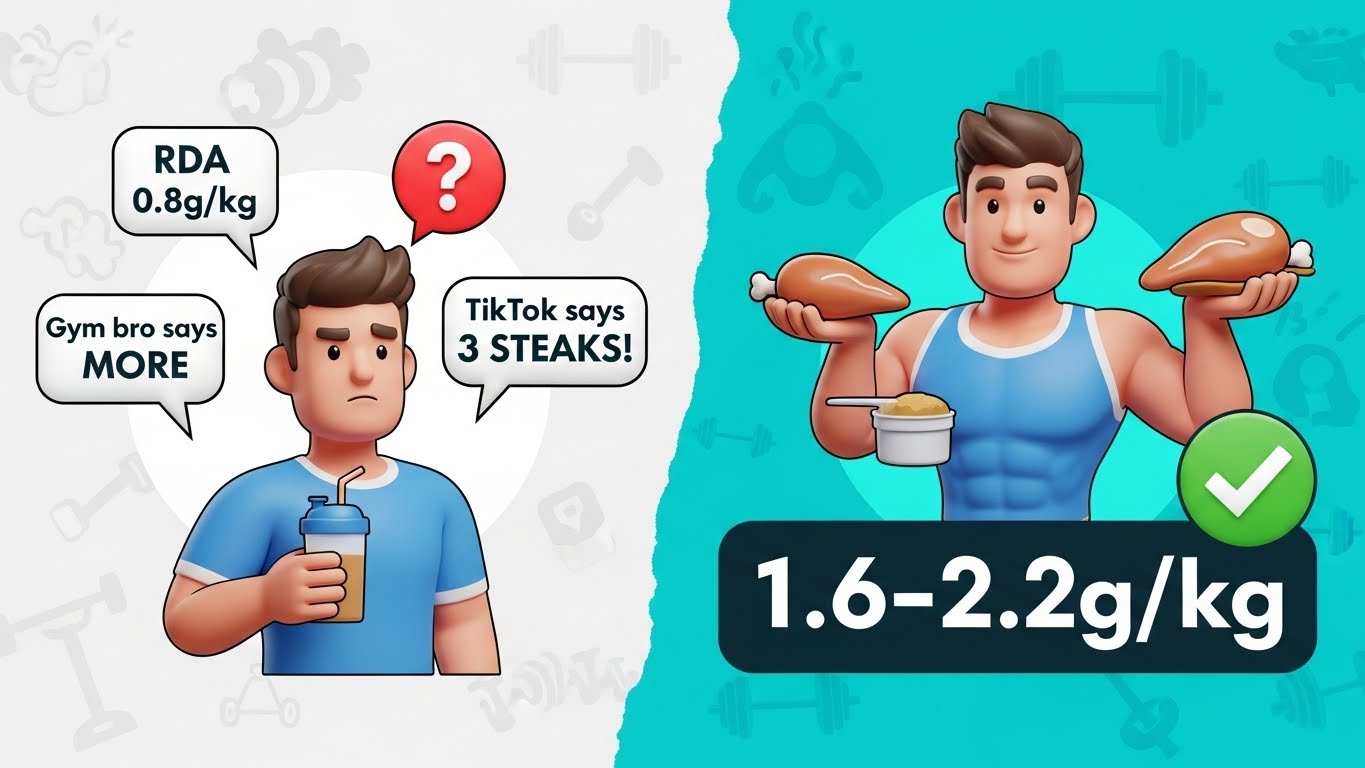

If you ask ten different people how much protein you need, you’ll get ten different answers. The government says one thing, your “gym bro” says another, and that influencer on TikTok says you need to eat three steaks a day.
So, who is right?
Protein is the building block of your muscles, skin, enzymes, and hormones.1 Getting the “right” amount is the difference between seeing results and spinning your wheels. Here is exactly how much you need based on your specific goals and activity level.
1. The “Minimum” vs. The “Optimum”
Most people look at the RDA (Recommended Dietary Allowance), which is 0.8 grams per kilogram of body weight.
The Catch: This number is the bare minimum required to prevent deficiency and keep you alive—not the amount required to thrive, build muscle, or lose fat. If you are active, the RDA is far too low.
2. The Science-Backed “Sweet Spot”
For anyone who exercises or wants to improve their body composition, the research (including a massive meta-analysis published in the British Journal of Sports Medicine) points to a specific range:
The Formula: 1.6g to 2.2g per kg of Body Weight
(Or roughly 0.8g to 1g per pound).
- If your goal is Fat Loss: High protein is essential to keep you full and prevent muscle wasting while in a calorie deficit.2
- If your goal is Muscle Gain: You need the upper end of this range to provide the “bricks” (amino acids) necessary for new muscle tissue.
3. Protein Needs by Lifestyle (Quick Reference)
Find your category below to see your daily target:
| Lifestyle Category | Protein Goal (per kg/lb) | Example (for 75kg / 165lb person) |
| Sedentary / Non-Lifter | 1.0g – 1.2g per kg | 75g – 90g |
| Endurance Athlete | 1.4g – 1.6g per kg | 105g – 120g |
| Strength Training / Fat Loss | 1.6g – 2.2g per kg | 120g – 165g |
4. Can You Eat “Too Much” Protein?
A common myth is that high protein damages healthy kidneys. Current research shows this is false for healthy individuals. However, there is a “point of diminishing returns.” Once you cross roughly 2.2g per kg, you aren’t necessarily building more muscle; you’re just eating expensive calories that could have been used for energy-dense carbs or healthy fats.
5. Timing: Does the “30-Minute Window” Matter?
You may have heard of the “Anabolic Window”—the idea that you must drink a protein shake within 30 minutes of lifting.
- The Reality: Total daily protein intake is 90% of the battle. * The Best Practice: Instead of obsessing over timing, aim to spread your protein across 3 to 5 meals throughout the day. This keeps “Muscle Protein Synthesis” (the growth signal) active around the clock.
How to Hit Your Goal (Pro Tips)
- Start with Breakfast: Most people eat zero protein at breakfast. Swap cereal for eggs or a Greek yogurt bowl to get a 30g head start.
- The “Palm” Rule: Each main meal should have a portion of protein the size of your palm.
- Supplement Wisely: If you can’t hit your numbers with whole food, a high-quality Whey or Plant-based protein powder is a convenient “insurance policy.”
The Bottom Line
If you want to look better, feel stronger, and stay full during a diet, aim for 1.6g to 2.2g of protein per kilogram of body weight. It is the single most effective dietary change you can make.