
Most lifters treat breathing as an afterthought. They either hold their breath until their face turns purple or they pant shallowly like they’re running a marathon. Both are mistakes that kill your strength and put your spine at risk.
If you want to lift heavier, protect your back, and avoid that “lightheaded” feeling after a heavy set, you need to master Biomechanical Breathing. Here is the logic-based guide to breathing for maximum power.
1. The Golden Rule: Exhale on Effort
In the simplest terms, you should coordinate your breath with the two phases of a lift: the Eccentric (lowering) and the Concentric (pushing/pulling).
- The Descent (Inhale): Breathe in as you lower the weight. This is when the muscle is lengthening.
- The Exertion (Exhale): Breathe out forcefully as you push or pull the weight.
- The Logic: Exhaling during the hardest part of the lift helps “brace” the core and prevents a dangerous spike in internal blood pressure.
2. The Valsalva Maneuver (The “Internal Weight Belt”)
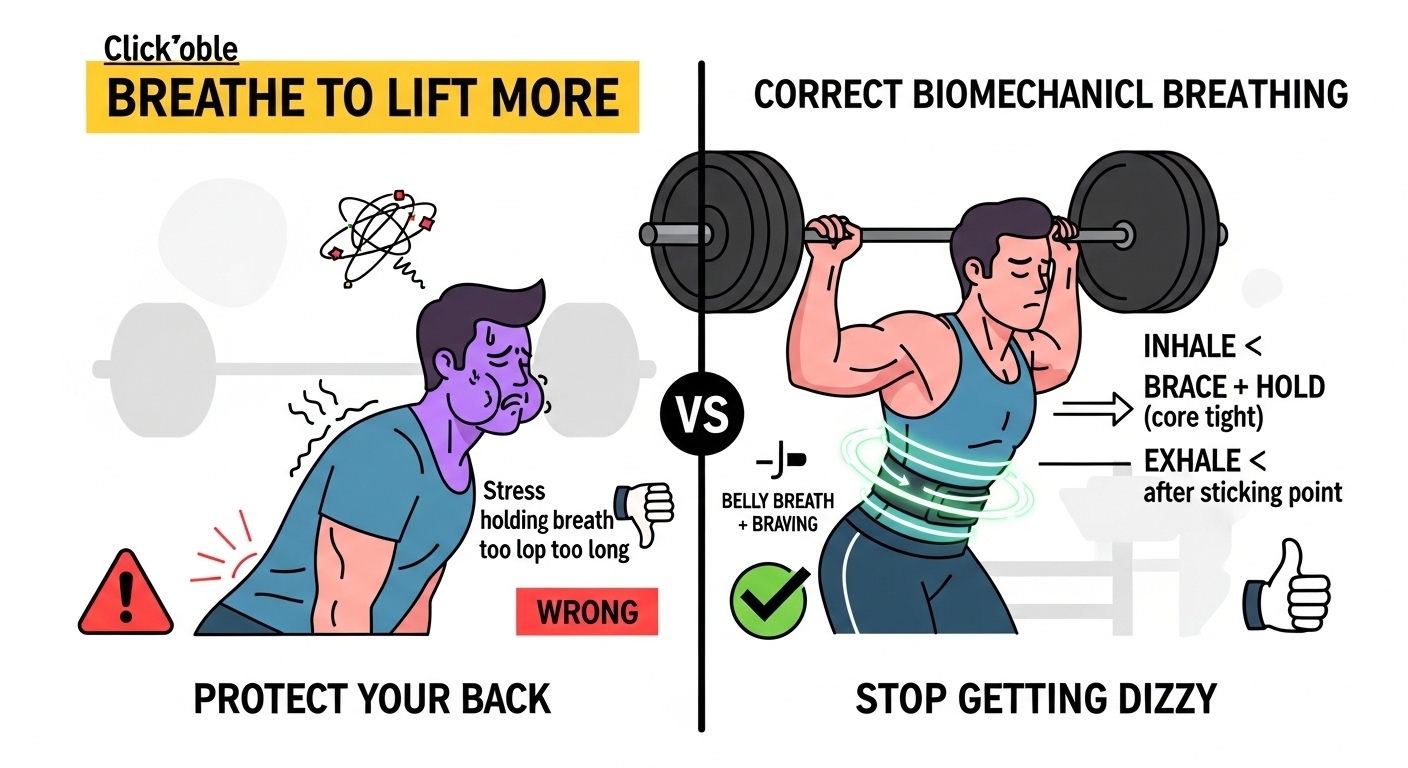
For heavy, compound lifts like Squats, Deadlifts, or Overhead Presses, “normal” breathing isn’t enough. You need Intra-Abdominal Pressure (IAP).
- The Technique: 1. Take a deep “belly breath” (not a chest breath).2. Hold that breath and “brace” your abs as if someone is about to punch you.3. Complete the hardest part of the rep.4. Exhale sharply once you are past the “sticking point.”
- Why it works: This creates a rigid cylinder of pressure around your spine. It turns your torso into a solid pillar, allowing you to transfer more force into the bar.
Note: If you have high blood pressure or heart conditions, consult a doctor before using the Valsalva Maneuver, as it significantly increases internal pressure.
3. Belly Breathing vs. Chest Breathing
If your shoulders rise when you take a breath, you’re doing it wrong. Chest breathing is shallow and inefficient.
- The Fix: Practice Diaphragmatic Breathing. Place a hand on your stomach; it should move out when you inhale and in when you exhale. This allows for full lung expansion and better oxygen exchange, which is critical during high-intensity sets taken to failure.
4. Don’t “Short-Circuit” Your Sets
A common mistake when training to failure is “gasping” for air mid-rep. This causes you to lose your core tension, making the weight feel 20% heavier than it actually is.
- The Strategy: Reset your breath at the “top” of the movement. For example, in a Bench Press, take your big breath while your arms are locked out, hold it as you lower and press, and exhale at the top again.
Breathing Cheat Sheet by Lift Type
| Lift Type | Breathing Strategy | Why? |
| Heavy Compound (Squat/Deadlift) | Valsalva (Hold & Brace) | Spinal safety and maximum rigidity. |
| Isolation (Curls/Extensions) | Standard (Inhale down, Exhale up) | Lower systemic pressure needed. |
| High Reps / Cardio | Rhythmic (Steady flow) | Prevents oxygen debt and lightheadedness. |
5. Avoiding the “Gym Blackout”
We’ve all seen videos of people fainting after a heavy pull. This happens because they held their breath too long or didn’t “vent” the pressure correctly.
- The “Hiss” Technique: Instead of a giant gasp, exhale through pursed lips (like a hiss) during the exertion. This releases pressure gradually while keeping your core braced.
The Bottom Line
Proper breathing is the “software” that runs your “hardware” (muscles). If you don’t breathe correctly, you’re leaving 10–15% of your strength on the table. Inhale to prepare, brace to protect, and exhale to finish.