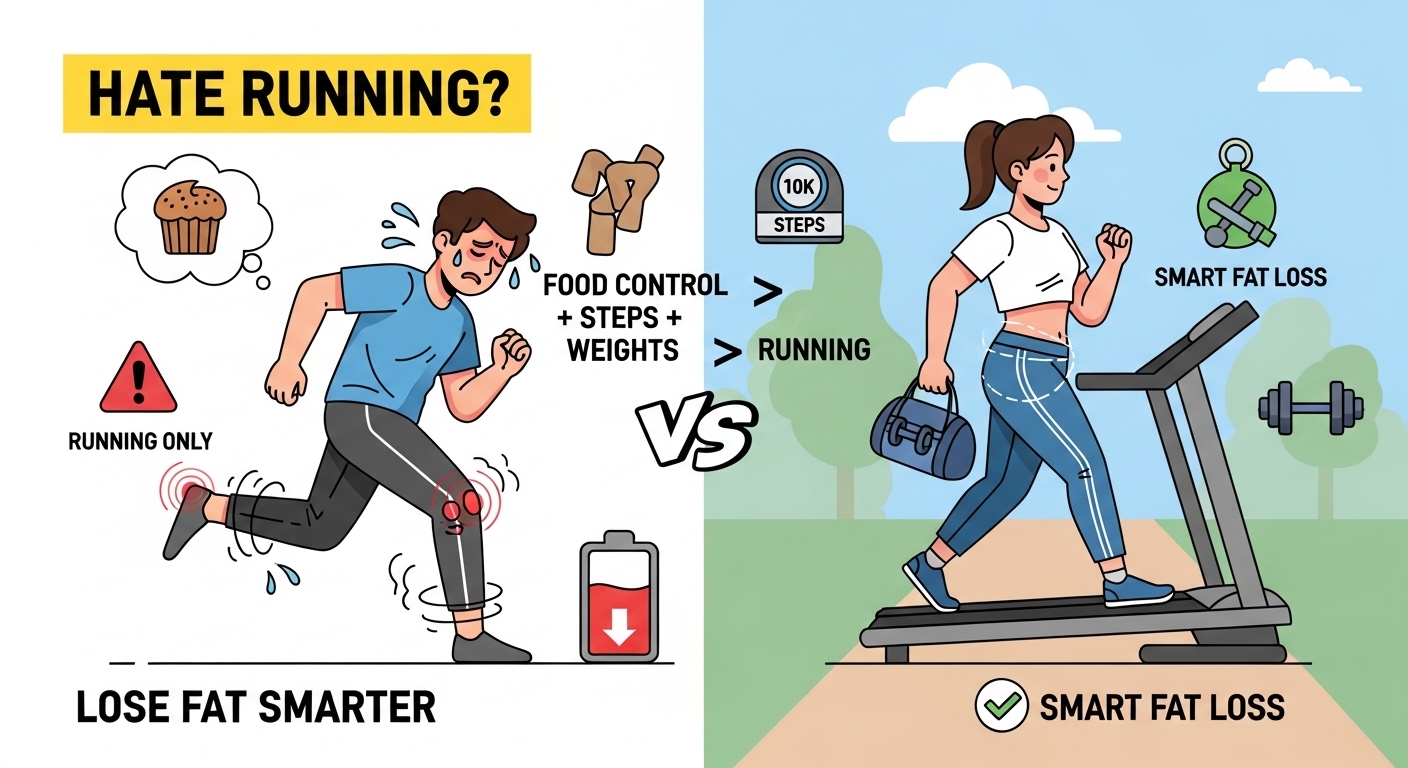

If you hate running, I have good news: Running is one of the least efficient ways to lose fat. While running burns a high number of calories per minute, it also causes significant joint stress, spikes hunger levels, and often leads to “over-compensation” (eating more because you feel you worked so hard). For fat loss, we don’t need a specific movement; we need a specific environment. Here is the no-BS logic on how to lose fat while keeping your feet firmly on the ground.
1. The 70/30 Rule: Nutrition First
The most important thing to understand is that you cannot outrun a bad diet, but you can certainly “out-diet” a lack of running.
- The Math: A 3-mile run burns roughly 300 calories. That is the equivalent of one medium-sized muffin.
- The Logic: It is infinitely easier to simply not eat the 300 calories than it is to spend 30 minutes sweating them off.
- The Strategy: Prioritize a Calorie Deficit and High Protein intake. This handles 70% of the fat-loss equation before you even enter the gym.
2. Leverage Your “NEAT” (The Secret Burn)
NEAT stands for Non-Exercise Activity Thermogenesis. It is the energy you burn doing everything except formal exercise.
- The Logic: Research shows that people who hit 10,000 steps a day burn significantly more fat over the long term than those who are sedentary all day but run for 30 minutes in the evening.
- The Fix: Focus on low-intensity, frequent movement. Take the stairs, park further away, or take a 10-minute walk after every meal. This burns fat without the “stress response” of running.
3. High-Intensity Resistance Training (HIRT)
If you want the “toned” look people associate with runners, you don’t need the road; you need the weights.
- The Science: Lifting weights increases your BMR (Basal Metabolic Rate). Muscle tissue is metabolically “expensive”—it requires energy just to exist.
- The “Afterburn”: Intense lifting sessions create a higher oxygen debt, meaning you burn more calories for hours after the workout (EPOC) compared to a steady-state run.
Running Alternatives for Fat Loss
| Method | Why it Works | Joint Impact |
| Incline Walking | Mimics the effort of running without the “pounding.” | Lowest |
| Heavy Lifting | Increases metabolism and builds “shape.” | Moderate |
| Cycling/Swimming | High-calorie burn with zero impact. | Lowest |
| Stairmaster | Extreme glute and leg recruitment. | Moderate |
4. The “Incline Walking” Hack
If you want the cardiovascular benefits of running without the pain, use the treadmill incline.
- The Logic: Walking at 3.0 mph on a 10-12% incline burns nearly the same amount of calories as a flat-ground jog, but because it is low-impact, it doesn’t cause the same muscle damage that interferes with your strength training.
The Bottom Line
Fat loss is a result of a consistent calorie deficit, not a specific cardio machine. If you lift weights 3–4 times a week, hit your daily step goal, and stay in a deficit, you will lose fat just as fast—if not faster—than someone who runs every day.
Scientific Evidence & PubMed Studies
- Diet vs. Exercise for Weight Loss: This systematic review found that dietary changes are far more effective for initial weight loss than exercise alone, reinforcing that running is not a requirement for fat loss.
- NEAT and Obesity: Research by Dr. James Levine at the Mayo Clinic shows that Non-Exercise Activity (walking, standing) is the primary factor that differentiates lean individuals from those with obesity.
- Metabolic Rate and Muscle Mass: This study confirms that resistance training preserves lean mass during weight loss, keeping your metabolism higher than cardio alone.