
You’ve finally committed. You’re hitting the weights, watching your portions, and staying consistent. You step on the scale expecting a win, but the number is… higher?
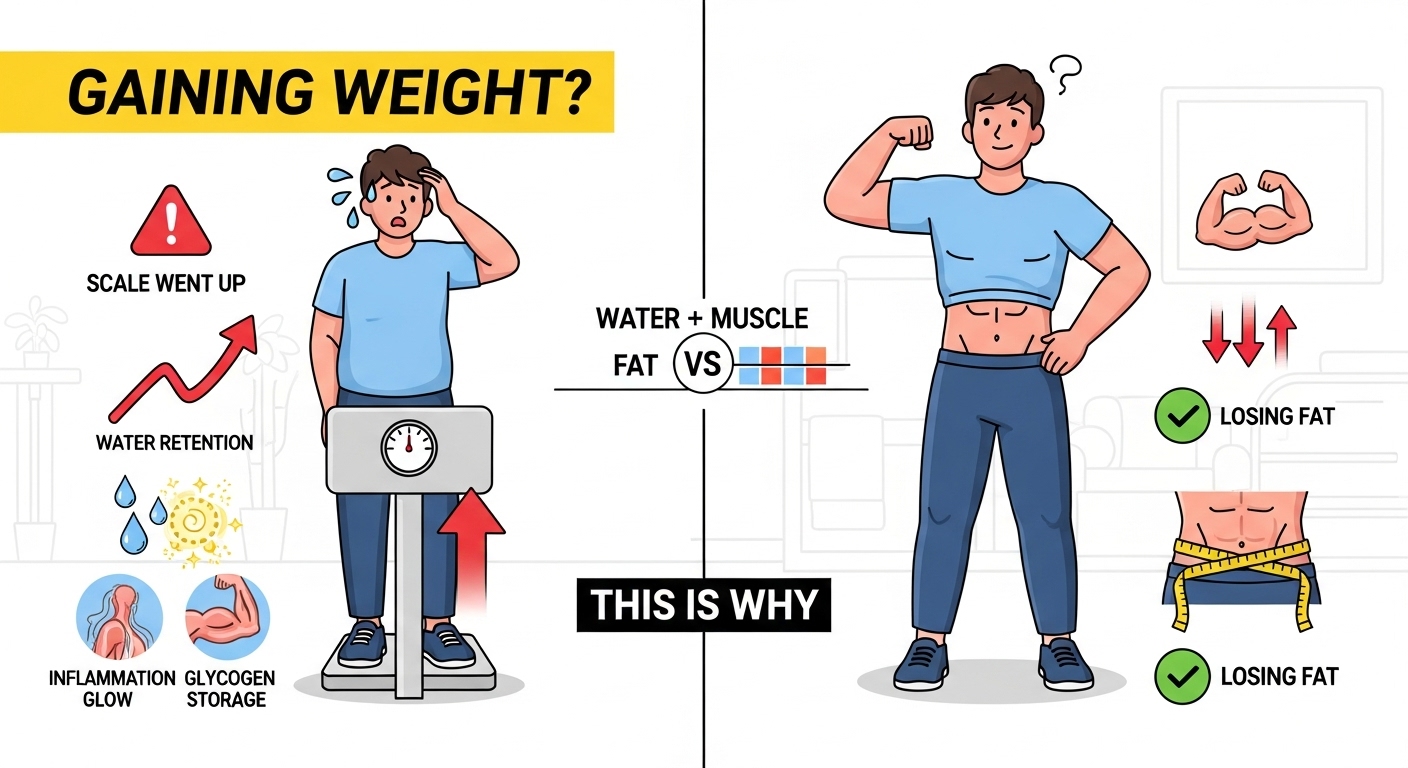
Before you throw your sneakers in the trash and declare that “exercise doesn’t work for me,” take a deep breath. This is a common biological phenomenon. Gaining weight in the first 2–4 weeks of a new program is actually a sign that your body is responding exactly how it should.
Here is the no-BS logic behind why the scale goes up when you start getting fit.
1. The “Water Sponge” Effect (Inflammation)
When you start a high-intensity training program, you are essentially causing microscopic damage to your muscle fibers. This is a good thing; it’s the “inroad” required for growth.
- The Logic: To repair that damage, your body initiates a localized inflammatory response. Inflammation requires fluid. Your body rushes water to the muscle tissues to shuttle in nutrients and shuttle out waste.
- The Result: You might be “holding” 2–4 lbs of water weight that wasn’t there last week. You aren’t fatter; you are just healing.
2. Glycogen Supercompensation
Muscle is 75% water, but it’s also a storage tank for energy called Glycogen (stored carbohydrates).
- The Science: When you start lifting weights, your body realizes it needs more “fuel on board” for these new physical demands. It begins to store more glycogen directly inside the muscle cells.
- The Math: Every gram of glycogen stored in your muscle carries 3 to 4 grams of water with it.
- The Outcome: Your muscles look fuller and tighter (the “pump”), but the scale reflects that extra fuel and water as weight gain. This is functional weight, not fat.
3. The “Newbie Gains” Reality
While building significant slabs of muscle takes time, beginners can experience a rapid shift in body composition.
- The Trade-off: Muscle tissue is much denser than fat tissue. It takes up about 20% less space than fat of the same weight.
- The Strategy: It is entirely possible to lose 2 lbs of fat and gain 2 lbs of muscle/water/glycogen in your first month. The scale says “zero change,” but your waist is smaller and your clothes fit differently. This is why the scale is a terrible tool for measuring progress in isolation.
Scale Weight vs. Reality: The Comparison
| Feature | Fat Gain | Initial “Gym” Weight Gain |
| Primary Cause | Consistent Calorie Surplus | Inflammation & Glycogen |
| Feel of Body | Soft / Loose | Firm / “Pumped” |
| Clothing Fit | Tight / Uncomfortable | Often Looser in the waist |
| Timeline | Weeks/Months of overeating | First 14–21 days of training |
4. The “Hunger Spike” Trap
While the first three reasons are purely physiological, there is one behavioral trap to watch out for.
- The Logic: Exercise increases energy expenditure, which can trigger an increase in the hunger hormone Ghrelin.
- The Warning: Many people unconsciously “reward” themselves for a workout by eating back the calories they burned—and then some. If you are eating 500 extra calories because you “worked hard,” you might actually be gaining a small amount of fat.
5. How to Track Real Progress
If the scale is lying to you, how do you know you’re winning? Use the Fitness Simplified metrics:
- The Training Log: Are you getting stronger? If your weights are going up, your “system” is working.
- Measurements: Use a tape measure around your waist. If the scale stays the same but your waist is shrinking, you are losing fat.
- Progress Photos: Photos don’t lie. Look for muscle definition in the shoulders and a “tightening” of the midsection.
The Bottom Line
The scale measures everything—bones, water, muscle, organs, and fat. It cannot tell the difference between “inflammation from a great workout” and “fat from a pizza.”
Stop obsessing over the daily fluctuations. Give your body 28 days to stabilize its water levels and glycogen stores. If you stay consistent with your intensity and keep your calories in check, the “gym weight” will eventually drop, revealing a leaner, harder physique underneath.
Scientific Evidence & Studies
1. Exercise-Induced Inflammation and Water Retention
When you stress muscles, they retain fluid to heal. This study explores the “repeated bout effect” and how the inflammatory response to muscle damage (DOMS) involves significant fluid shifts.
- The Science: Research shows that muscle damage leads to an increase in extracellular water as part of the inflammatory repair process.
2. Glycogen Storage and Water Weight
As you start training, your body increases its “fuel tank” capacity. This classic study quantifies exactly how much water is bound to glycogen.
- The Math: The study confirms that for every gram of glycogen stored, the body stores approximately 3 to 4 grams of water. In a new trainee, this can easily account for a 3–5 lb swing on the scale.
3. The “Newbie Gains” / Recomposition Effect
This study proves that it is physiologically possible to lose fat and gain muscle simultaneously (Body Recomposition), especially in “untrained” individuals.
- The Result: Participants showed significant increases in lean body mass (muscle/water) while simultaneously decreasing fat mass, leading to a scale weight that stayed stagnant or slightly increased despite a leaner appearance.
4. Compensation and Post-Exercise Hunger
This research investigates why people often “eat back” their calories. It discusses how the brain signals a “reward” response after exercise, leading to increased caloric intake that can mask fat loss.
- The Warning: The study found that individuals often overestimate the calories burned in a workout and compensate by overeating, potentially leading to actual fat gain if not tracked.