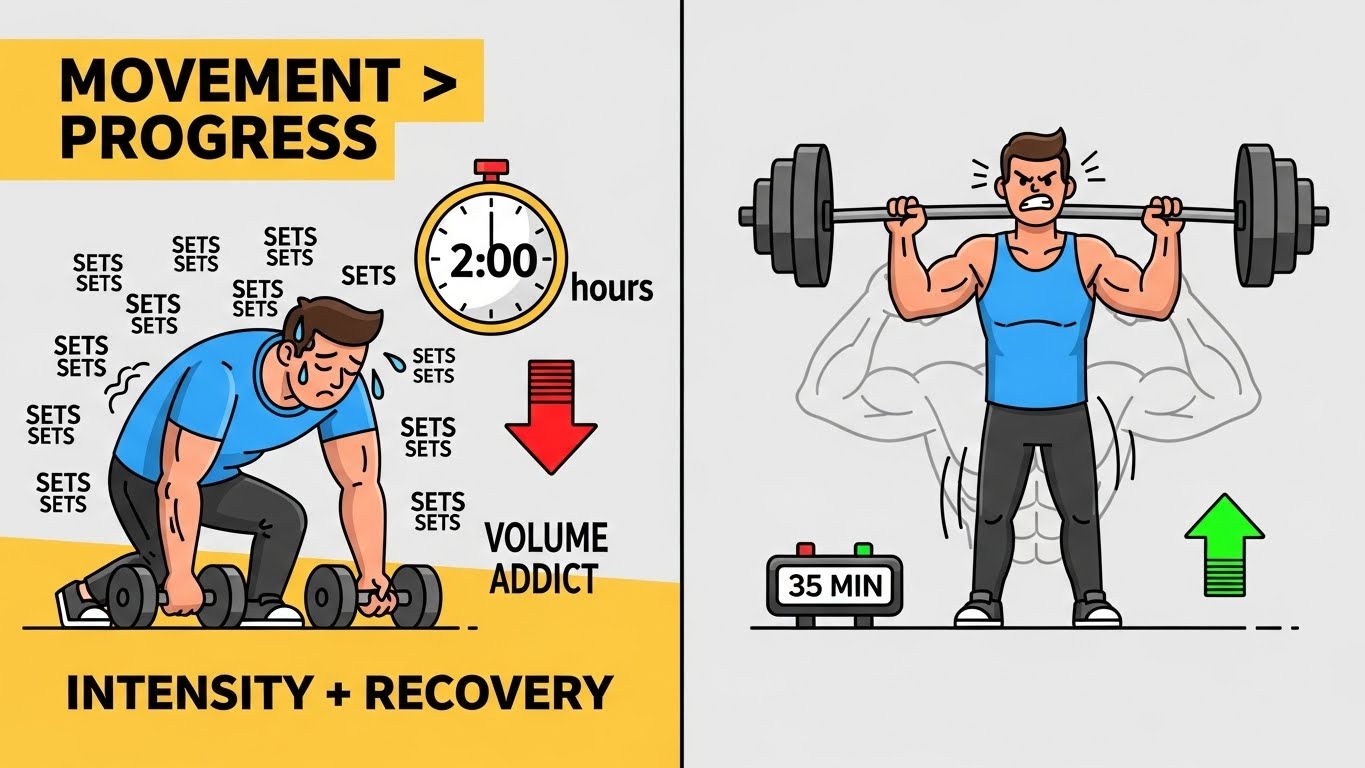

You’ve been going to the gym five, maybe six days a week. You’re performing set after set, exercise after exercise, and yet, when you look in the mirror, the reflection hasn’t changed in months. You’re following the “pro” routines, yet you remain at a standstill.
Why? Because you are likely committing the ultimate sin in bodybuilding: You are confusing movement with progress.
Muscle growth is not a matter of “luck” or “magic.” It is a matter of biological law. If you aren’t gaining, it is because you have failed to satisfy the two fundamental requirements of the human body: Intensity and Recovery.
1. You Lack the “Biological Necessity”
The human body is an incredibly economical organism. It does not want to build muscle because muscle is a metabolically expensive tissue to maintain. It will only grow if it is forced to do so by an emergency.
- The Mistake: Most people perform “sub-maximal” sets. If you do 10 reps but could have done 12, you have signaled nothing to your body. You have merely demonstrated your current capacity.
- The Fix: You must train to absolute muscular failure. You must push a set until it is physically impossible to complete another rep with perfect form. This “flips the switch” of the growth mechanism. Anything less is just “calisthenics.”
2. The Overtraining Trap: More is Not Better
This is the most misunderstood concept in fitness. People think that if 1 hour of training is good, 2 hours must be better. This is a catastrophic error.
Training is a negative act. It is a stressor that creates a “hole” in your recovery reserves. You do not grow in the gym; you grow while you are away from it.
- The Reality: If you train too often, you are digging a new hole before the previous one has been filled. You aren’t “building” muscle; you are merely treading water in a state of chronic fatigue.
- The Solution: If you are truly training with 100% intensity, you cannot—and should not—train more than 2 or 3 days a week.
3. You are “Burning the Oil” of Your Recovery
Your body has a strictly limited supply of energy for recovery. This energy must first be used to keep your heart beating, your lungs breathing, and your brain functioning. Only the leftover energy is used for muscle growth.
If you are training for 90 minutes and doing 20 sets per muscle group, you are using up all your “recovery oil” just to survive the workout. There is nothing left to build new tissue.
- The Rule: Keep your workouts brief. 30 to 45 minutes of high-intensity effort is the absolute limit.
The “Checklist of Failure”: Why Your Growth Has Stopped
| The Problem | The High-Intensity Solution |
| Too many sets | Reduce to 1–2 “all-out” sets per exercise. |
| Too many days | Take at least 48–72 hours of rest between sessions. |
| Low intensity | The set only counts if the last rep is impossible. |
| Socializing at the gym | Get in, trigger the growth, and get out. |
4. The Caloric Deficit Myth
You cannot build a mountain out of a molehill. If you are training like a titan but eating like a bird, you are giving your body the “order” to grow without providing the “materials.”
Muscle growth requires a caloric surplus. Your body needs a reason to believe that energy is abundant. If you aren’t gaining weight, you aren’t eating enough. It is that simple.
The Bottom Line
Muscle growth is a result of a precise cause-and-effect relationship. The cause is a high-intensity stimulus that threatens the body’s survival. The effect is the growth of new muscle to meet that threat—but only if the body is given the time and nutrients to do so.
Stop being a “volume addict.” Stop looking for a “new” routine. Increase your intensity, decrease your frequency, and force your body to change.