
It is one of the most frustrating experiences in fitness: You’re hitting the gym four days a week, you’re sweating, you’re exhausted, yet the scale is stuck—or worse, moving up.
If you’re “doing everything right” and still not seeing progress, you haven’t broken the laws of physics. You’ve likely fallen into one of the common biological or behavioral traps that neutralize the hard work you do in the gym.
Here are the five science-backed reasons why exercise alone isn’t making you lose weight.
1. The “Halo Effect” (Overestimating Calories Burned)
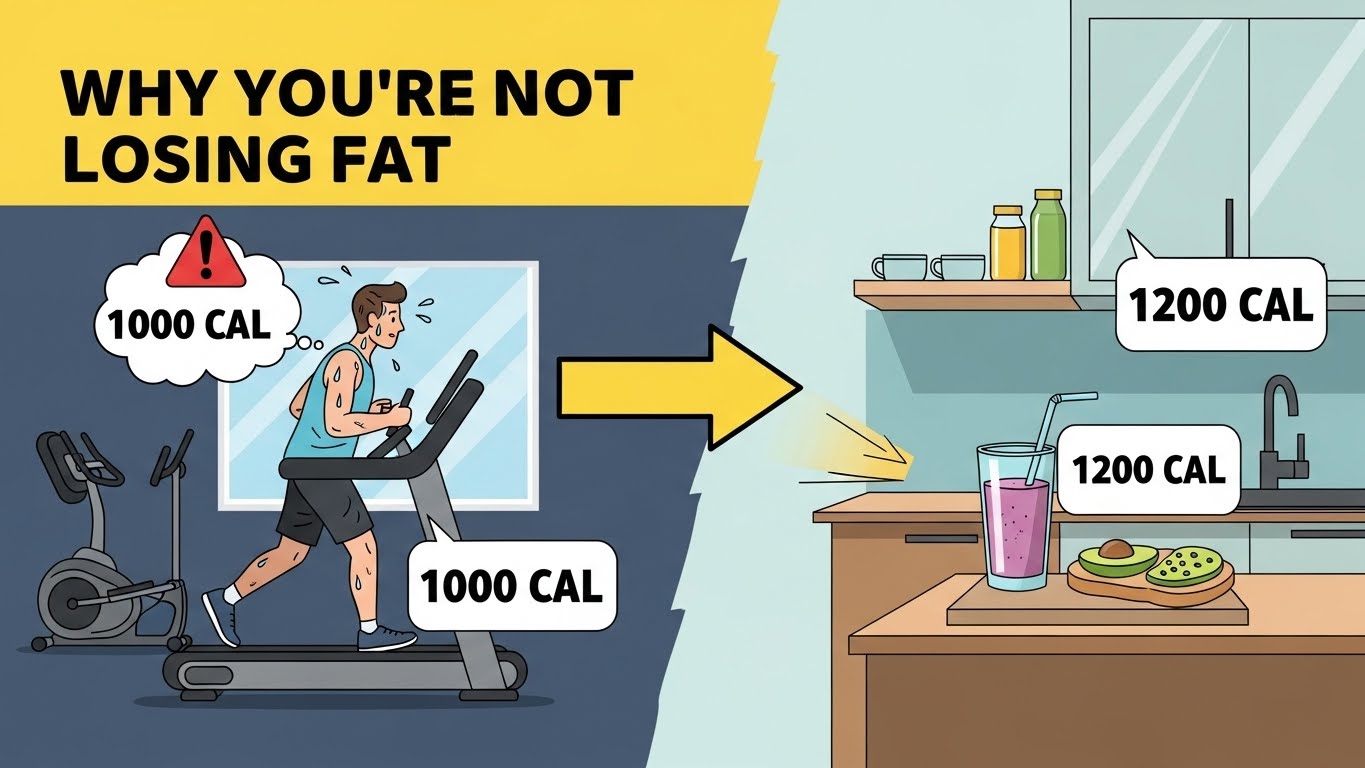
Most people—and almost all fitness trackers—vastly overestimate how many calories are burned during a workout. A grueling 45-minute spin class might burn 400 calories, but a single “healthy” avocado toast or a post-workout smoothie can easily contain 500.
- The Reality: Exercise is for fitness; nutrition is for fat loss. You cannot out-train a bad diet.
- The Fix: Use exercise to build muscle and heart health, but rely on a calculated calorie deficit to drive weight loss.
2. Metabolic Compensation (The “Laziness” Reflex)
Your body is a survival machine, not a weight-loss machine. When you burn a lot of energy during a workout, your body often subconsciously compensates by making you move less the rest of the day. This is called NEAT (Non-Exercise Activity Thermogenesis).
- The Trap: You crush a morning workout, but then you sit for 8 hours and lounge on the couch all evening because you’re tired.
- The Fix: Track your daily steps. Ensure that a 1-hour gym session doesn’t result in 23 hours of total stillness.
3. The “I Earned It” Mentality
Psychologically, we tend to reward ourselves for hard work. After a heavy lifting session, you might justify an extra serving at dinner or a sugary latte.
- The Trap: This “compensatory eating” often leads to eating back more calories than you actually burned during the exercise.
- The Fix: Separate your “fueling” from your “training.” View food as a tool to recover, not a reward for moving.
4. Water Retention and Muscle Inflammation
If you’ve recently started a new exercise program, the scale might stay the same (or go up) due to water weight. When you challenge your muscles, you cause micro-tears, leading to inflammation and glycogen storage. Your body holds onto extra water to repair this tissue.
- The Reality: This isn’t fat; it’s recovery.
- The Fix: Stop obsessing over daily scale weight. Track your body measurements (waist circumference) and how your clothes fit instead.
5. You’re Gaining Muscle (Body Recomposition)
Muscle is significantly denser than fat. If you are lifting weights, you may be losing fat and gaining muscle simultaneously. In this scenario, your body composition is improving drastically, but the total weight on the scale remains unchanged.
- The Result: You look leaner, your pants feel looser, and your metabolism is higher, even if the number on the scale is “stuck.”
- The Fix: Take progress photos. The mirror often tells the truth that the scale hides.
How to Break the Plateau: Your Action Plan
| The Problem | The Simple Solution |
| Eating too much | Start tracking calories for 1 week to find your baseline. |
| Sitting too much | Aim for 8,000 steps in addition to your workouts. |
| Muscle gain | Use a body fat caliper or progress photos. |
| Hidden liquid calories | Switch flavored coffees/sodas for water or black coffee. |
The Bottom Line
Exercise is the best thing you can do for your long-term health, but it is a supplement to a good diet, not a replacement for it. If the scale isn’t moving, the answer is almost always found in the kitchen, not the gym.