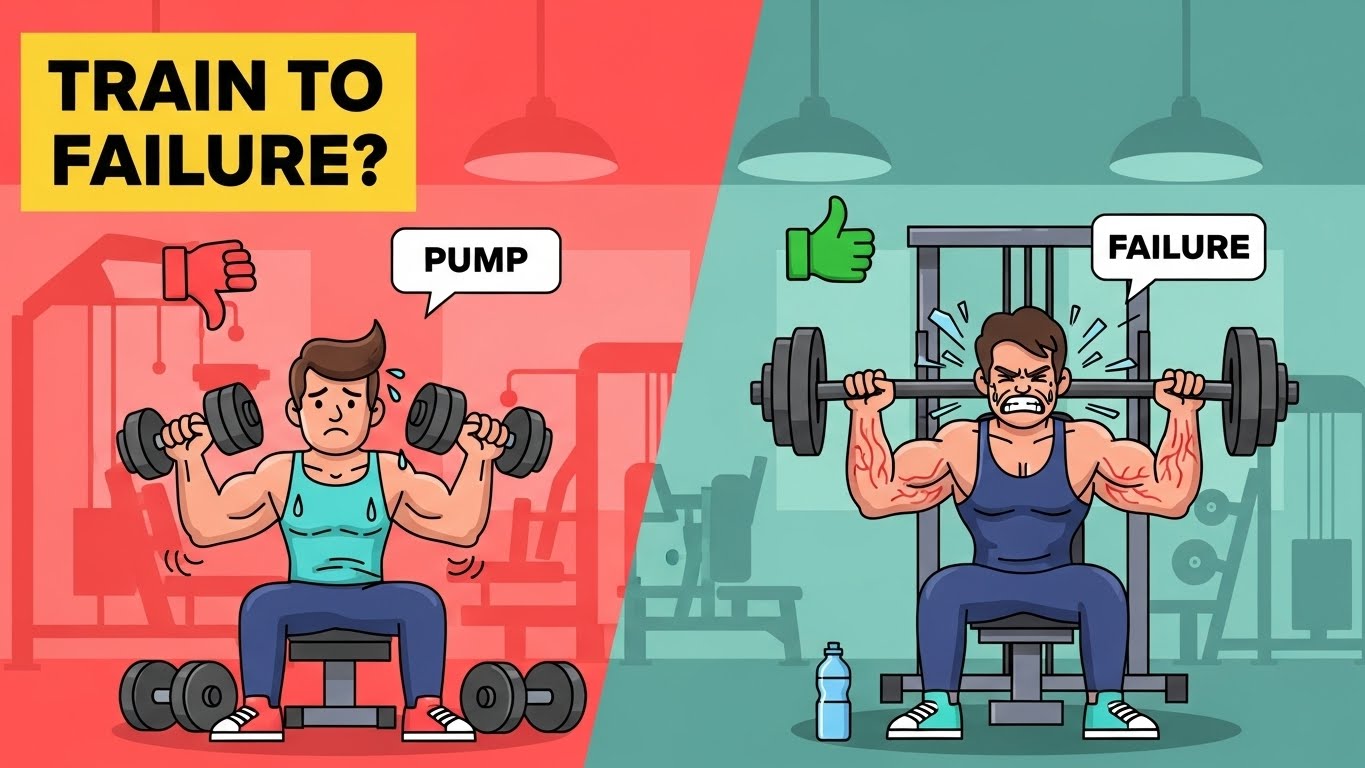

In every gym in the world, you’ll see two types of people. The first is doing set after set, hour after hour, looking for a “pump.” The second walks in, performs one or two bone-crushing sets that look like a near-death experience, and walks out.
The question is: Is reaching absolute muscular failure necessary for growth, or is it a recipe for burnout?
If you want to stop “exercising” and start “building,” you need to understand the science of the biological trigger. Here is why training to failure might be the only way to unlock your true potential.
1. The “Switch” Theory: Why 99% of Sets are Wasted
Think of muscle growth like a light switch. You can push a light switch with 1lb of pressure or 100lbs of pressure; as long as the switch flips, the light turns on.
Muscle growth is the same. Your body is biologically designed to not grow muscle because muscle is metabolically expensive to maintain. To force it to change, you must provide an “emergency” stimulus.
- The Logic: If you perform a set and stop 2 reps early, you haven’t signaled an emergency. You’ve stayed within your current capacity.
- The Failure Edge: Only the final, impossible rep—the one where your muscles physically cannot complete the movement despite your maximum effort—tells your brain: “We aren’t strong enough. We must grow.”
2. The Inroad: Quality Over Quantity
Many lifters confuse “volume” with “productivity.” They believe doing 20 sets of chest is better than 2. But if none of those 20 sets reached absolute failure, they were simply “junk volume.”
By training to total muscular failure, you create a deep “inroad” into your functional capacity. You are effectively draining the battery to zero. Once that battery is drained, more sets are not only unnecessary—they are counterproductive. One set taken to a state of absolute, high-intensity failure is worth more than a dozen sets of “moderate” effort.
3. The Recovery Trap: The “Hidden” Growth Killer
The most common mistake in the gym isn’t training too hard; it’s training too often. When you train to true failure, you don’t just fatigue your muscles; you tax your central nervous system (CNS). Muscle growth happens after the gym, during the recovery phase.
- The Warning: If you train to failure today and go back to the gym tomorrow, you are likely interrupting the growth process before it’s finished.
- The Solution: High-intensity training requires high-intensity rest. If you are truly training to failure, you should only be in the gym 2 or 3 days a week.
How to Train to Failure Safely
Training to failure is a tool, not a toy. To do it correctly, follow these rules:
- Perfect Form Only: Failure doesn’t mean “cheating.” The set ends when you can no longer move the weight with perfect technique.
- Use Machines for Safety: Reaching failure on a Squat or Bench Press can be dangerous without a spotter. Use high-quality machines (like a Leg Press or Smith Machine) to safely push your limits without the risk of being pinned.
- The “One Set” Rule: If you truly reached absolute failure, you shouldn’t be able to do a second set of that same exercise. If you can, you didn’t go hard enough the first time.
Failure vs. Volume: The Comparison
| Feature | Traditional Volume Training | High-Intensity Failure Training |
| Time in Gym | 90–120 Minutes | 20–40 Minutes |
| Effort per Set | Moderate (70–80%) | Maximum (100%) |
| Frequency | 5–6 days a week | 2–3 days a week |
| Primary Driver | Accumulated Fatigue | Biological Stimulus |
The Bottom Line
Training to failure is the only way to ensure you have “flipped the switch” for growth. However, it requires a level of mental toughness that most people simply don’t possess. If you are willing to endure the brief, intense pain of a set taken to the absolute limit, you can achieve more growth in two workouts a week than most people achieve in two months.
Go to the gym, trigger the growth, and then get out and let it happen.