
“How long until I see results?” It’s the first question everyone asks when they pick up a dumbbell. We see the “6-week transformation” ads and the Hollywood actors gaining 20lbs of muscle for a role in three months—but what is the reality for a natural lifter?
The truth is that muscle growth is a relatively slow biological process. However, if you have a solid system, you can see visible changes much faster than you think.
Here is the science-backed breakdown of how long it actually takes to build muscle, based on your experience level.
1. The “Newbie Gains” Phase (0–12 Months)
If you are new to consistent lifting, you are in the “Golden Era.” Because the stimulus is brand new, your body is hyper-responsive to training.
- The Timeline: You can expect to see noticeable muscle definition within 4 to 8 weeks.
- The Potential: A beginner can realistically gain 1lb to 2lbs of muscle per month in their first year.
- Why it happens: Your nervous system is learning to recruit muscle fibers, and your protein synthesis levels stay elevated longer after a workout.
2. The Intermediate Phase (1–3 Years)
After the first year, the “easy” gains are gone. Your body has adapted, and progress requires more precision in your nutrition and recovery.
- The Timeline: Changes become visible in 3 to 6-month blocks.
- The Potential: An intermediate lifter can expect to gain 0.5lb to 1lb of muscle per month.
- The Strategy: This is where Progressive Overload becomes non-negotiable. You have to fight for every extra rep and pound on the bar.
3. The Advanced Phase (3+ Years)
For those who have been training correctly for several years, muscle growth slows to a crawl. You are nearing your genetic potential.
- The Potential: Gaining 2lbs to 5lbs of muscle per YEAR is considered a massive success.
- The Focus: At this stage, it’s about “polishing” the physique, improving weak points, and mastering the mind-muscle connection.
4 Factors That Accelerate (or Kill) Your Progress
While biology has its limits, these four variables determine whether you hit the fast track or the plateau:
A. The Caloric Surplus
You cannot build a house without bricks. To build muscle at the maximum rate, you need to be in a slight caloric surplus (eating 200–300 calories above maintenance). Without the extra energy, your body won’t have the “building materials” to create new tissue.
B. Protein Frequency
Muscle Protein Synthesis (MPS) is the process of repairing and growing muscle. To keep MPS “turned on” all day, you should eat 20–40g of protein every 3 to 4 hours.
C. Training Intensity
If you aren’t training within 1–3 reps of failure, you aren’t giving your body a reason to change. Most people don’t see results because their workouts aren’t “hard” enough to trigger a biological adaptation.
D. Sleep: The Silent Builder
90% of your muscle growth happens while you sleep. If you are getting 5 hours of sleep, you are effectively cutting your growth potential in half. Aim for 7–9 hours to maximize growth hormone release.
The Realistic “Visual” Timeline
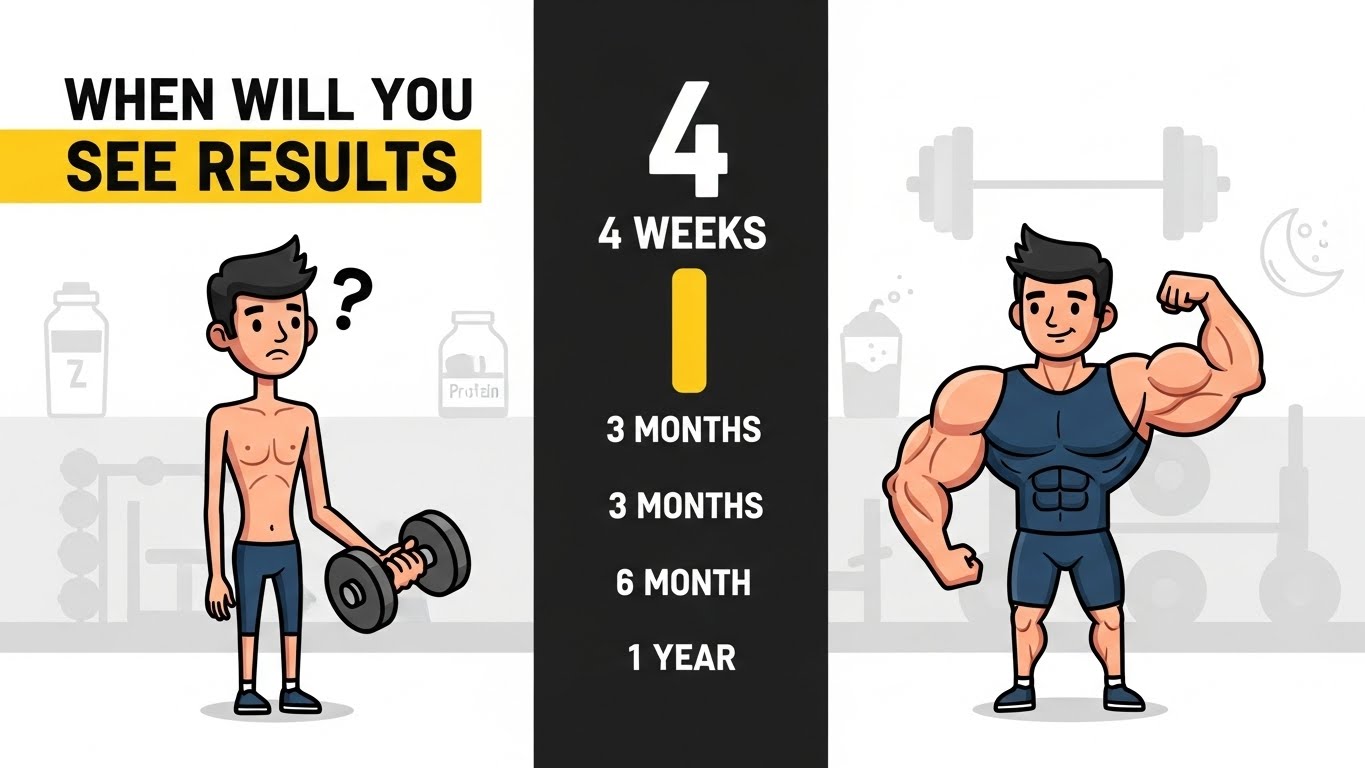
| Timeframe | What You’ll See |
| Week 1-4 | Improved strength (neurological), better “pump,” more energy. |
| Week 8-12 | Clothes fit differently; friends start noticing a change in your shoulders/arms. |
| 6 Months | Significant changes in body shape; visible muscle mass even in a t-shirt. |
| 1 Year | A total body transformation. This is where the “who is that?” comments start. |
The Bottom Line
Building a classic, muscular physique is a marathon, not a sprint. While you can see “pump” and “tone” in a few weeks, building significant slabs of muscle takes months of consistent effort.
Don’t look at the scale every day; look at your training log. If you are getting stronger and eating enough protein, the muscle has to follow.