
If you walk into any commercial gym today, you will see a sea of people performing the same exercises, with the same weights, for the same number of repetitions that they did six months ago. These people are not “training”; they are merely “exercising.”
If you want to transform your physique, you must understand that the human body is a masterpiece of economy. It does not want to grow muscle. Muscle is a metabolic burden. To force your body to build new tissue, you must present it with a challenge it cannot currently meet. This is the essence of Progressive Overload.
1. The Biological Imperative: The “Why” Behind the Weight
Your body possesses a specific level of functional capacity. As long as the work you do in the gym remains within that capacity, your body has no reason—none whatsoever—to change.
Progressive Overload is the act of systematically increasing the stress placed upon the body during exercise. It is the only way to signal to your brain that your current strength is inadequate for survival. When you push beyond your previous limits, you “flip the switch” that triggers the growth mechanism.
2. The Logic of the Logbook
You cannot rely on “feeling” or “the pump” to measure progress. The pump is a temporary physiological state; it is not an indicator of growth. The only objective proof that you are growing is increased performance.
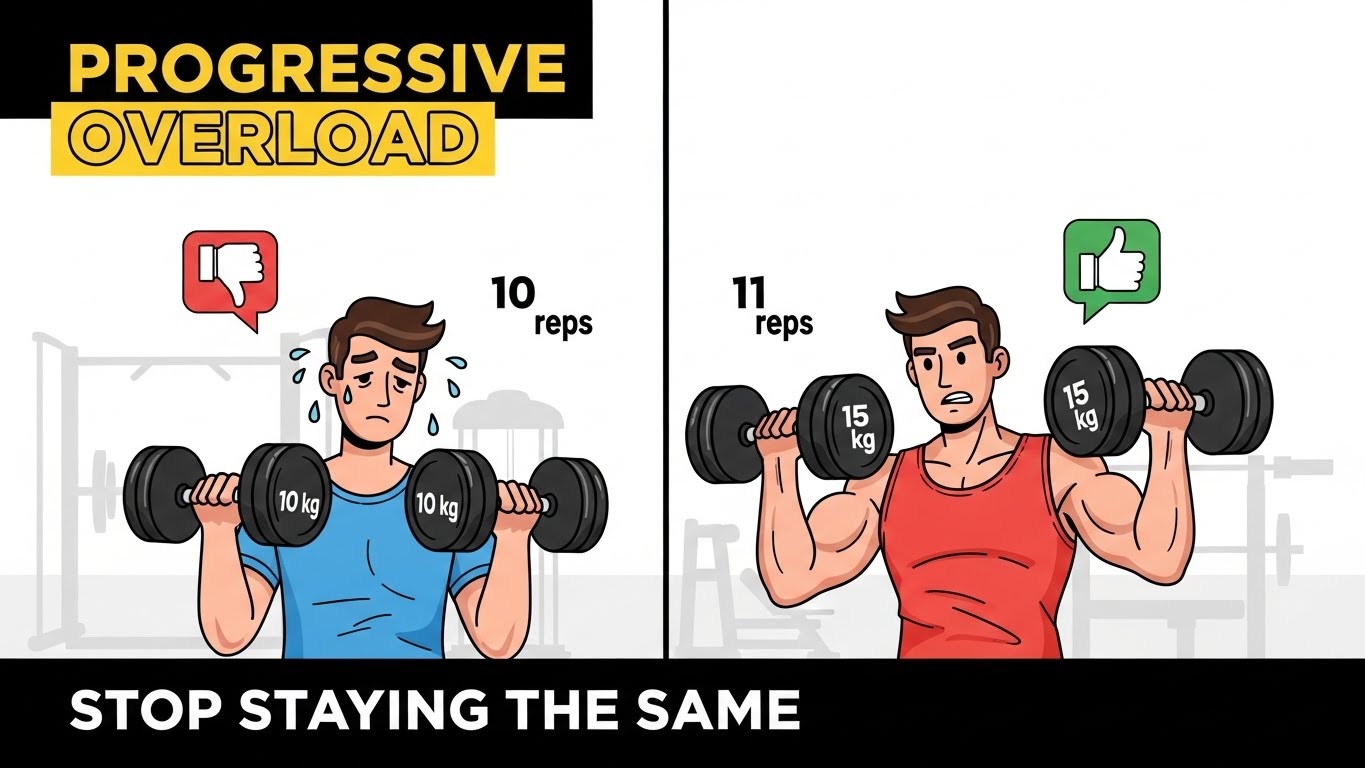
- The Rule: If you performed 100lbs for 10 reps last week, you must perform 100lbs for 11 reps today, or 105lbs for 10 reps.
- The Result: If the numbers in your logbook are not steadily rising, you are not building muscle. Period. You are simply burning calories.
3. Intensity Over Duration
Most people attempt to “overload” by adding more sets, more exercises, and more hours in the gym. This is a catastrophic mistake. Adding more volume only drains your recovery ability without necessarily increasing the stimulus for growth.
True overload is found in Intensity.
Instead of doing more, you must do better. One set taken to the point of absolute muscular failure—where a further rep is physically impossible despite your greatest mental effort—provides a more powerful growth signal than twenty sets of moderate activity.
4 Methods to Achieve Progressive Overload
To keep your body in a state of constant adaptation, you should focus on these four levers:
- Increased Resistance: Adding weight to the bar. This is the most direct form of overload.
- Increased Repetitions: Performing more work with the same weight.
- Increased Time Under Tension: Slowing down the eccentric (lowering) phase to force the muscle to work harder.
- Improved Form: Performing the same weight and reps but with “stricter” control, removing momentum and forcing the target muscle to do 100% of the work.
The “Inroad” and the Recovery Gap
When you successfully achieve progressive overload, you create an “inroad” into your body’s energy reserves. This is a high-intensity stressor that requires significant time to repair.
If you overload the muscle on Monday and return to the gym on Wednesday while you are still “recovering,” you are short-circuiting the process. You must allow the body enough time to not only return to its previous level but to over-compensate (grow) to be ready for the next challenge.
| Feature | Mere Exercise | Progressive Training |
| Goal | To get tired / sweat | To beat the logbook |
| Weights | Random / “Feels good” | Systematically heavier |
| Mindset | Maintenance | Biological Warfare |
| Frequency | High (5-6 days) | Low (2-3 days) |
The Bottom Line
Progressive overload is the only law of muscle growth that matters. If you are not stronger today than you were two weeks ago, you are standing still. Stop looking for “variety” and start looking for progress. Pick up a heavier weight, focus your mind with savage intensity, and force your body to evolve.