
If you’ve been trying to lose weight, you’ve probably been told that peanut butter is a “fitness staple.” It’s everywhere—in protein smoothies, on rice cakes, and labeled as a “great source of protein.”
I’m going to be the bearer of bad news: If your goal is fat loss, peanut butter is one of the worst foods you can keep in your pantry.
It isn’t “unhealthy” in the traditional sense, but from a purely mathematical standpoint, it is a weight-loss nightmare. Here is why you need to put the jar down if you want the scale to move.
1. The “Protein” Myth: Let’s Look at the Math
People call peanut butter a protein source, but if we look at the numbers, peanut butter is actually a fat source with a bit of protein in it.
- Two Tablespoons (32g) of Peanut Butter:
- Calories: ~190
- Protein: 7-8g
- Fat: 16g
To get 25g of protein (what you’d get in a single chicken breast), you would have to eat nearly 600 calories of peanut butter. By that point, you’ve consumed almost a third of your daily calorie budget just to get a snack-sized amount of protein. That is a terrible trade-off for someone in a deficit.
2. The Volume Problem (You’re Still Hungry)
Success in weight loss is all about Satiety per Calorie. You want to eat foods that take up a lot of space in your stomach for very little energy.
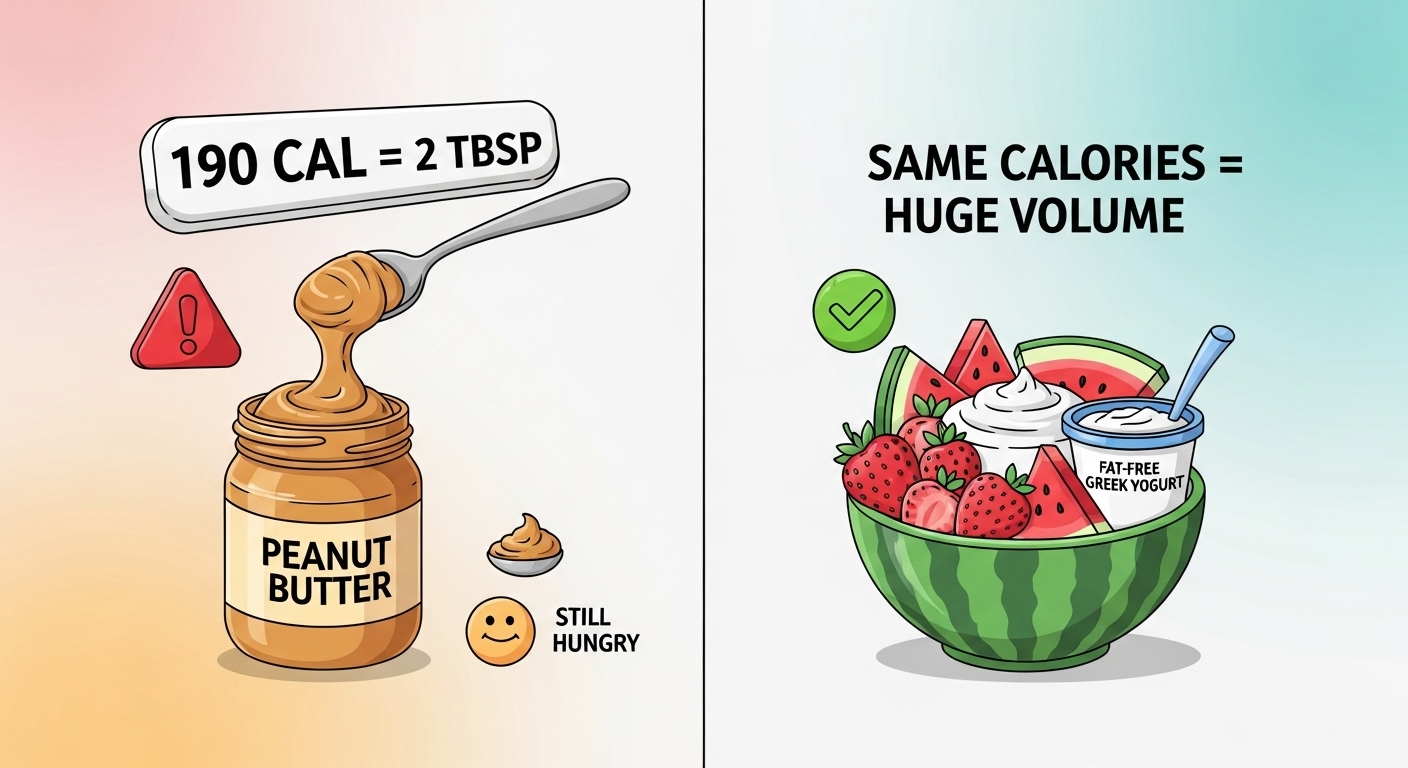
Peanut butter is the opposite. It is “calorie dense” and “low volume.” Two tablespoons is roughly the size of a ping-pong ball. Have you ever eaten two tablespoons of peanut butter and felt “full”? Probably not. In fact, most people find it so hyper-palatable that they end up eating four or five tablespoons without realizing it.
The Reality: You can eat 200 calories of peanut butter in 30 seconds, or you can eat 200 calories of strawberries (which is nearly two pounds of fruit). Which one do you think will keep you full until dinner?
3. The “Two Tablespoon” Lie
Nobody actually eats the “serving size” of peanut butter. When you dip a spoon into the jar, you are likely pulling out 300–400 calories in one “scoop.” Because it is so dense, a tiny measurement error can be the difference between a calorie deficit and a calorie plateau.
What to Eat Instead: High-Volume, High-Protein Heroes
If you want to lose weight without feeling like you’re starving, you need to swap the “dense” fats for “high-volume” options.
The Protein Powerhouses (High Protein / Low Calorie)
- Egg Whites: Almost pure protein. You can eat a massive bowl of egg whites for the same calories as one spoonful of peanut butter.
- Greek Yogurt (0% Fat): 17g of protein for only 100 calories. It’s thick, creamy, and actually keeps you full.
- White Fish (Cod/Tilapia) or Chicken Breast: The gold standard for “bang for your buck” protein.
The Volume Kings (High Volume / Low Calorie)
- Watermelon & Strawberries: You can eat these until your stomach is physically full for less than 200 calories.
- Potatoes (Boiled/Air-Fried): Ranked as the #1 most satiating food on the Satiety Index. Much better than rice or pasta for fat loss.
- Cruciferous Veggies: Broccoli, cauliflower, and cabbage. These are “free” foods—fill half your plate with them to add bulk to your meals without adding calories.
The “Fitness Simplified” Verdict
I’m not saying you can never have peanut butter again. But you have to treat it for what it is: a calorie-dense treat, not a weight-loss tool. If you are struggling to stay in your calorie deficit because you’re always hungry, look at your fats. Swap the peanut butter for Greek yogurt or a massive bowl of fruit, and watch how much easier your “system” becomes to manage.
Are you struggling to hit your protein goals without going over your calories? Tell me what your favorite snacks are, and I’ll give you a “high-volume” alternative that tastes just as good!