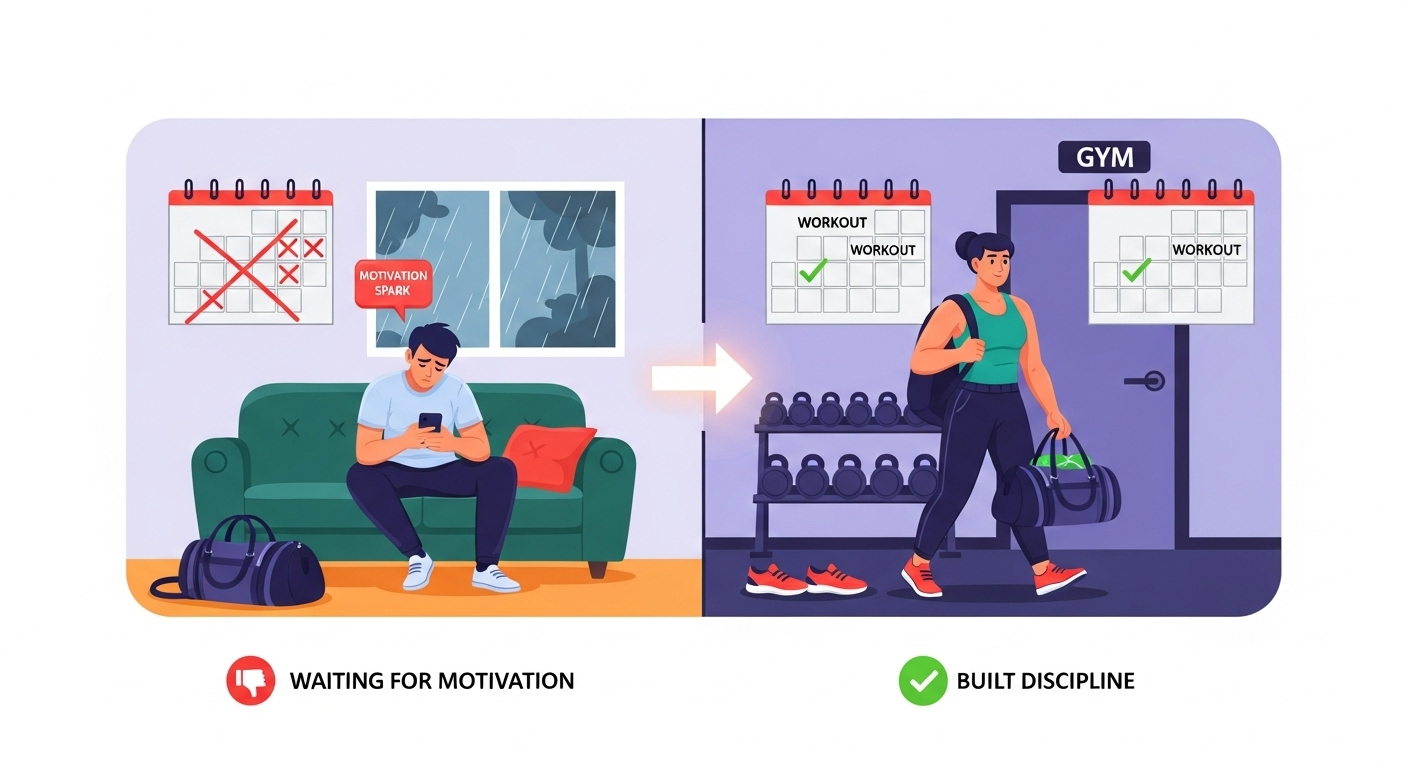

You watch a high-energy “hype” video, feel a surge of inspiration, and crush a workout. But three days later, it’s raining, you’re tired from work, and that “spark” is nowhere to be found.
Here is the hard truth: Motivation is a biological variable, not a character trait. If you rely on “feeling like it” to go to the gym, you will fail. High-performers don’t have more motivation than you; they have better systems. If you want to stay consistent for years, not just weeks, you need to move from “Motivation” to “Discipline.”
Here is the simplified blueprint to staying on track when you don’t feel like it.
1. Stop Chasing the “High”
Motivation is like a sugar rush—it feels great while it lasts, but it always crashes. Biologically, your brain is wired to conserve energy. It will always argue for the couch over the squat rack because it views unnecessary effort as a threat to your survival.
- The Logic: Expect to feel unmotivated. When the feeling of “I don’t want to go” arises, recognize it as a standard biological reflex, not a sign that you should stay home.
- The Fix: Treat your workout like a non-negotiable appointment. You don’t “wait to feel motivated” to go to work or brush your teeth; you do them because they are requirements of your lifestyle.
2. The Power of “Small Wins”
Every time you complete a workout, you aren’t just burning calories; you are casting a vote for your new identity.
- The Strategy: In the beginning, the goal isn’t the workout—it’s the habit.
- The 10-Minute Rule: On days when your motivation is zero, tell yourself you only have to train for 10 minutes. If you still want to leave after that, you can.
- The Result: 90% of the time, once you’ve started, you’ll finish. Even if you don’t, you’ve maintained the habit of showing up, which is far more important than any single training session.
3. Environment Design: Reduce Friction
Willpower is a limited resource. If you have to search for your shoes, find your headphones, and pack a bag all before the gym, you will run out of “mental fuel” before you get out the door.
- The Fix: Automate your environment. Pack your gym bag the night before. Place your sneakers by the door. Pre-plan your workout so you don’t have to “think” once you enter the gym.
- The Goal: Make the path to the gym as frictionless as possible.
Motivation vs. Discipline: The Comparison
| Feature | Relying on Motivation | Building Discipline |
| Foundation | Feelings / Emotions | Logic / Systems |
| Consistency | Erratic & Unreliable | Constant & Predictable |
| Trigger | “Hype” videos | The Calendar |
| Long-term Success | Very Low | Guaranteed |
4. Track Data, Not Mirror Reflections
The mirror is a terrible motivator because it changes slowly. You can’t see muscle growing in real-time, which leads to frustration.
- The Fix: Track Performance. If you did 10 reps last week and 11 reps today, you have objectively improved. That data provides a “logical” reward for your brain that the mirror cannot. Focus on the numbers in your training log, and the physique will follow as a side effect.
5. Find Your “Minimum Effective Dose”
One of the biggest motivation killers is the “all-or-nothing” mentality. You think if you can’t do a full 90-minute session, it’s not worth going.
- The Simplified Approach: In line with our High-Intensity Training philosophy, a 20-minute intense session is infinitely better than a 0-minute session. Brevity makes the habit easier to maintain. You don’t need hours; you need focus.
The Bottom Line
Motivation gets you started, but systems keep you going. Stop waiting for the “feeling” to strike. Design your life so that the gym becomes an automatic part of who you are. When you stop asking “Should I go?” and start saying “It’s 5:00 PM, I’m going,” you’ve already won.