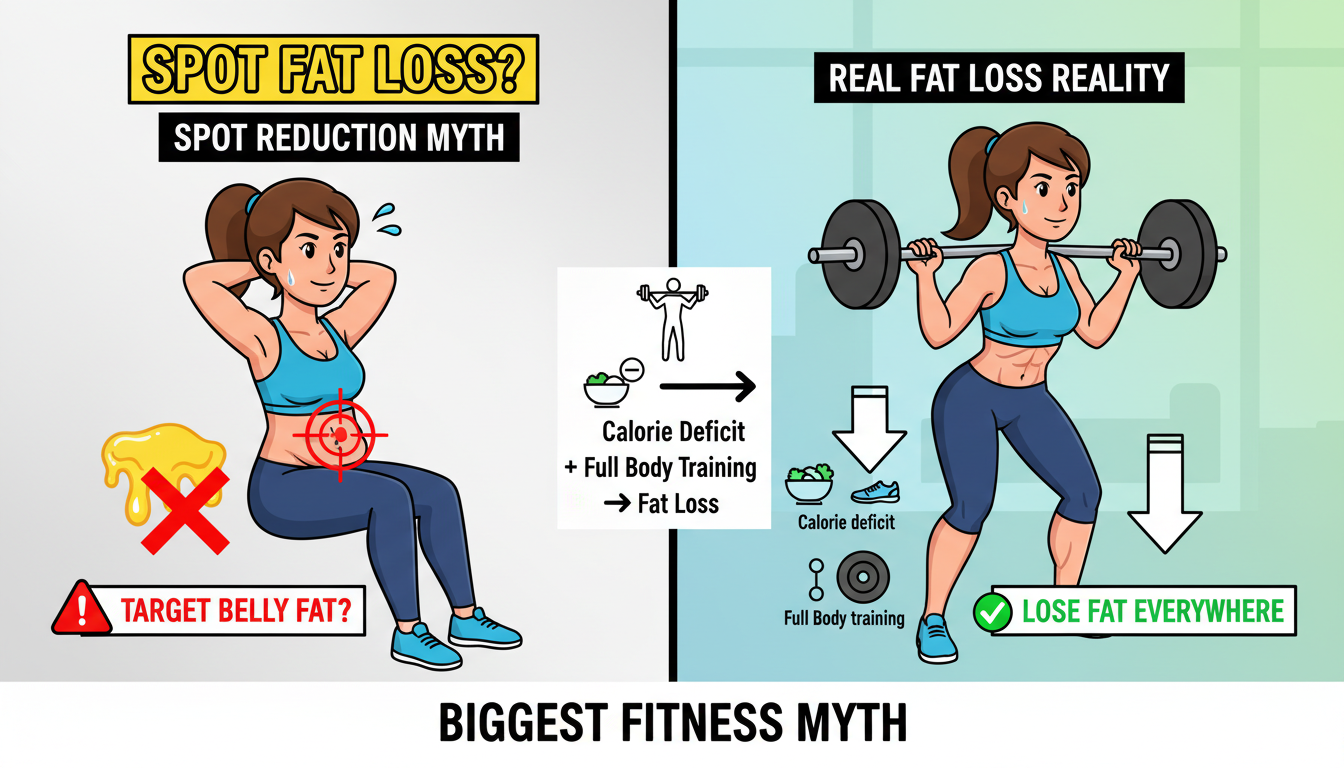

We’ve all seen the advertisements: “Do this one 5-minute ab circuit to melt away stubborn belly fat!” or “The secret move to lose your love handles!”
It sounds logical. You want to lose fat in your midsection, so you work the muscles in your midsection. Unfortunately, the human body does not work like a vending machine. You cannot pick where you want to lose fat by exercising that specific area. This is the myth of Spot Reduction, and it’s the primary reason many people spend months doing core workouts without ever seeing a change in their waistline.
Here is the no-BS science of how fat loss actually happens.
1. The “Energy Tank” Logic
Think of your body fat as a giant, interconnected fuel tank for your body. When you perform an exercise—whether it’s bicep curls or crunches—your muscles require energy ($ATP$).
- The Reality: The energy your muscles use doesn’t come from the fat sitting on top of them. It comes from the bloodstream, which draws fatty acids from fat cells located anywhere and everywhere in the body.
- The Result: Doing sit-ups burns a very small amount of energy, and that energy might be pulled from your chin, your calves, or your arms, but not necessarily your belly.
2. Genetics: The “Last In, First Out” Rule
Your DNA determines your “fat storage map.” Most people have a “problem area” (usually the midsection for men and the hips/thighs for women) where the body prefers to store fat first.
- The Logic: The area where you store fat first is almost always the area where you will lose it last. * The Strategy: You cannot “convince” your body to change its genetic priority. To lose the belly fat, you have to continue a calorie deficit until your body has no choice but to tap into its “long-term storage” in the midsection.
3. The “Muscle vs. Fat” Illusion
Many people confuse “building muscle” with “losing fat.”
- The Mistake: If you have 20% body fat and you do a massive amount of core training, you will develop very strong, thick abdominal muscles. However, if you haven’t addressed your nutrition, those muscles will simply sit underneath the fat, potentially making your midsection look wider rather than leaner.
- The Fix: You need High-Intensity Training to build the muscle shape, and a Calorie Deficit to peel back the layer of fat covering it.
Spot Reduction vs. Systemic Fat Loss
| Feature | The “Spot Reduction” Myth | The “Systemic” Reality |
| Method | Crunches/Side-bends | Calorie Deficit + Full Body Lifting |
| Fat Loss Area | Targeted (Midsection) | Total Body (Genetic Order) |
| Efficiency | Very Low | High |
| Result | Hidden Muscle | Visible Definition |
4. Why “Stubborn” Fat is Harder to Burn
There is a biological reason why belly fat is “stubborn.” Fat cells in the midsection often have a higher density of Alpha-receptors (which slow down fat breakdown) compared to Beta-receptors (which speed it up).
- The Fix: This isn’t a reason to give up; it’s a reason to be consistent. Blood flow to these “stubborn” areas is often lower. High-intensity resistance training and general movement (like walking) help increase systemic blood flow, making it easier for your body to mobilize those fatty acids when the deficit is present.
5. The Role of Stress and Cortisol
While you can’t exercise away belly fat specifically, you can hormonally encourage it to stay. High levels of Cortisol (the stress hormone) are closely linked to increased abdominal fat storage.
- The Logic: If you are overtrained, underslept, and chronically stressed, your body is more likely to shuttle fat toward your organs (visceral fat) as a protective measure.
- The Solution: Prioritize sleep and recovery just as much as your training.
The Bottom Line
Abs are made in the gym, but they are revealed in the kitchen. Stop wasting 20 minutes of your workout on endless crunches. Focus on big, compound movements that burn more total energy and maintain a consistent, logical calorie deficit. When you lower your overall body fat percentage, your “spot-specific” problems will solve themselves.