
Walk into any gym, and you’ll see people wearing hoodies in the summer, wrapping themselves in plastic, or sitting in saunas for an hour—all in an attempt to “sweat out the fat.”
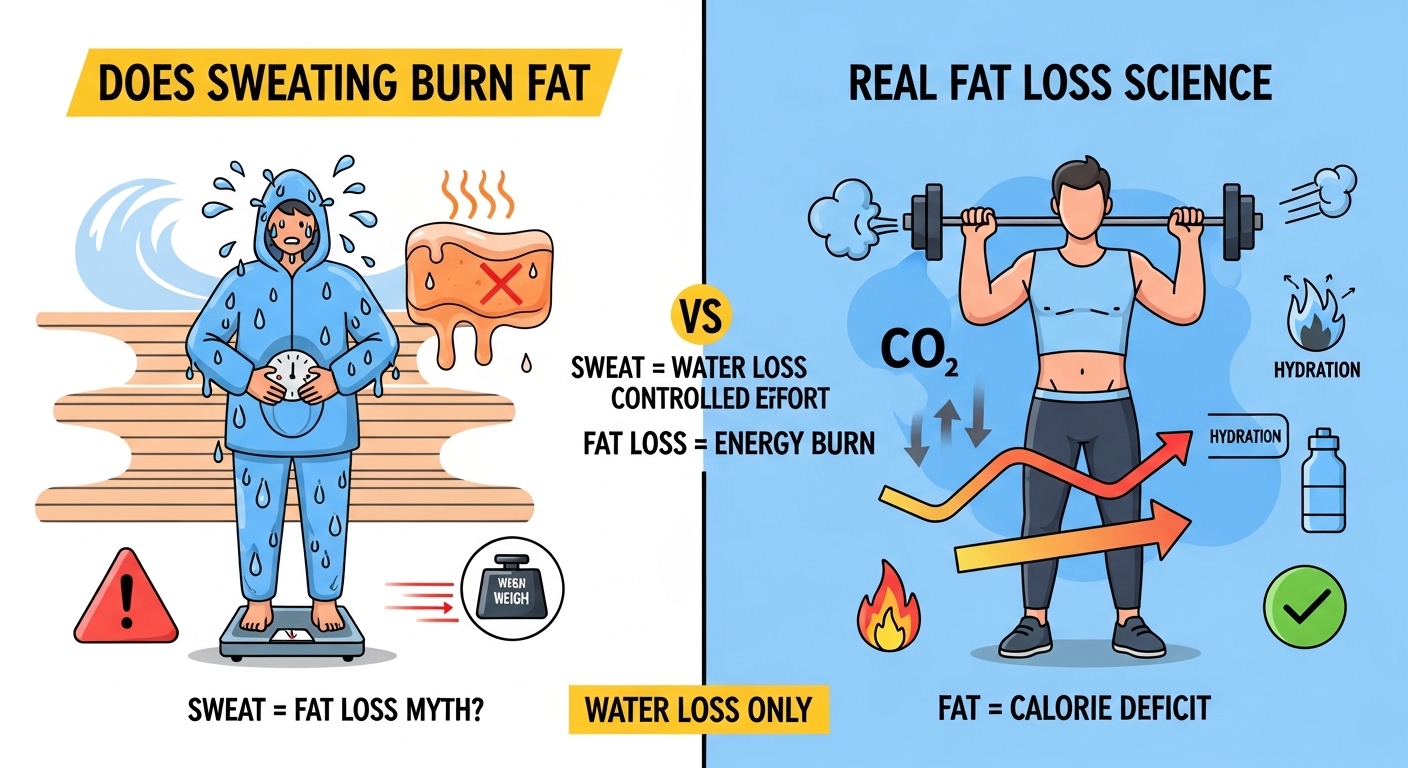
It’s an easy mistake to make. If you weigh yourself before a workout and then again after a heavy sweat session, the scale will be lower. But here is the cold, hard biological reality: Sweat is a cooling mechanism, not a fat-burning mechanism. If you are losing weight through sweat, you aren’t losing fat; you’re just becoming dehydrated.
1. The Logic of the “Cooling System”
Sweating is your body’s way of preventing you from dying of heatstroke. It is thermoregulation, not metabolism.
- The Process: When your internal temperature rises (due to exercise, heat, or even stress), your sweat glands release water and electrolytes onto your skin. As that water evaporates, it carries heat away from your body.
- The Fat Link: There is no fat in sweat. Fat must be broken down chemically (oxidized) and exhaled as Carbon Dioxide ($CO_2$) and excreted as water through your internal systems. It does not “leak” through your pores.
2. The Scale Lie: Water Weight vs. Fat Tissue
The “weight loss” people see after sweating is Transient Fluid Loss.
- The Math: If you lose 2 lbs during a hot workout, you have simply lost 2 lbs of water. The moment you drink a bottle of water or eat a meal, that weight will return.
- The Danger: Trying to “force” a sweat (like wearing a sauna suit) can actually decrease your fat loss. Why? Because the extreme heat causes you to fatigue faster, meaning you can’t train with the high intensity required to actually stimulate muscle growth and fat oxidation.
3. Sweating Does Not Equal Intensity
You can sweat profusely while sitting in a sauna doing absolutely nothing. Conversely, you can have a high-intensity, muscle-building workout in a cold room and barely break a sweat.
- The Variable: Some people are “heavy sweaters” due to genetics, high caffeine intake, or a high body mass index. Others have “efficient” cooling systems and stay dry.
- The Better Metric: Instead of looking at your shirt, look at your training log. Did you lift more weight? Did you move with more power? Those are the indicators of a successful “inroad” into your fat stores—not the puddles on the floor.
Sweat vs. Real Fat Loss: The Breakdown
| Feature | Sweating | Fat Oxidation (Burning) |
| Primary Goal | Cooling the body | Providing energy |
| Output | Water & Electrolytes | $CO_2$ (Exhaled) & Energy |
| Scale Impact | Immediate (Temporary) | Gradual (Permanent) |
| Effort Required | Can be passive (Heat) | Requires Calorie Deficit |
4. The One “Pro” to Sweating
While sweating doesn’t cause fat loss, there is a correlation.
- The Link: Intense exercise usually generates heat as a byproduct of muscle contraction. Therefore, sweating is often a sign that you are working hard.
- The Caveat: Don’t chase the sign; chase the work. If you focus on the sweat, you might choose a “hot yoga” class over a heavy lifting session, even though the lifting session will burn more fat and build more muscle in the long run.
5. The “Detox” Myth
You may have heard that you need to “sweat out toxins.”
- The Reality: This is a marketing lie. Your liver and kidneys handle 99% of your detoxification. Sweat is 99% water and small amounts of salt and minerals. You cannot “sweat out” a bad diet or environmental pollutants.
The Bottom Line
If you want to lose fat, stop trying to turn your workout into a sauna session. Focus on High-Intensity Training that forces your body to adapt and a Nutrition System that keeps you in a deficit.
A soaked t-shirt is a sign that you were hot. A leaner waistline is a sign that you were disciplined.