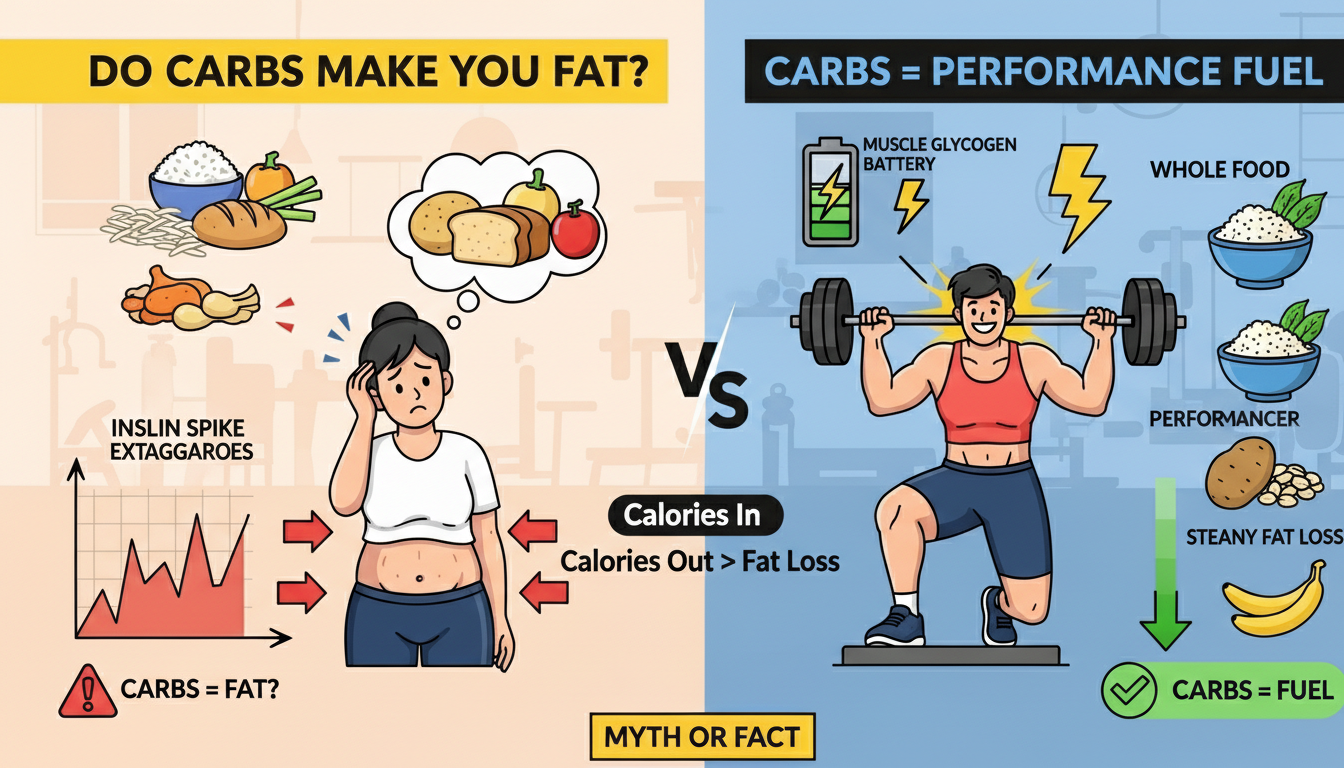

If you follow fitness trends, you’ve likely been told that carbohydrates are the enemy. The logic usually goes like this: “Carbs spike insulin, insulin stores fat, therefore carbs make you fat.”
It sounds scientific, but it’s an oversimplification that leads to unnecessary restriction and “diet burnout.” If you want a lean, high-performance physique, you need to stop viewing carbs as “fat-storage molecules” and start viewing them as performance fuel. Here is the no-BS truth about carbs and fat loss.
1. The Energy Balance Bottom Line
The most comprehensive nutritional studies ever conducted have shown that as long as calories and protein are equal, there is no significant difference in fat loss between low-carb and high-carb diets.
- The Logic: Fat loss is determined by a Calorie Deficit. If you burn more than you consume, you will lose fat.
- The Reality: People often lose weight quickly on “Low Carb” (Keto) diets, but it’s usually because they’ve inadvertently reduced their total calories by cutting out entire food groups, not because carbs are inherently fattening.
2. The Glycogen “Scale Lie”
When people cut out carbs, they often lose 5–7 lbs in the first week. This isn’t fat; it’s water.
- The Science: For every gram of carbohydrate (glycogen) your body stores in its muscles, it holds about 3 to 4 grams of water. * The Result: When you stop eating carbs, your body flushes that water. You look “flatter” and the scale drops, but your actual body fat percentage hasn’t changed. As soon as you eat a bagel, that weight comes right back.
3. Insulin: The “Gatekeeper” Myth
While it is true that insulin inhibits fat burning ($lipolysis$) in the short term, it is not a “fat-storage switch” that stays on forever.
- The Logic: Insulin’s primary job is to move nutrients (glucose and amino acids) into your cells. If you are in a calorie deficit, the insulin spike from a potato doesn’t matter because your body still has an overall energy shortage. It will return to “fat-burning mode” as soon as your blood sugar stabilizes.
- The Benefit: Insulin is actually anti-catabolic, meaning it helps prevent muscle breakdown. This is vital for maintaining your metabolism during a fat-loss phase.
Carbs vs. No Carbs: The Trade-off
| Feature | Low-Carb Diet | High-Carb (Moderate) Diet |
| Initial Weight Loss | Very Fast (Water) | Gradual |
| Workout Intensity | Often Lower (Low Fuel) | High (Optimal Fuel) |
| Muscle Preservation | Moderate | High (Insulin Sparing) |
| Sustainability | Difficult for many | Higher / More Flexible |
4. The “Hyper-Palatable” Trap
If carbs aren’t “bad,” why do people struggle with them? The problem isn’t the carbohydrate; it’s the combination.
- The Enemy: Pure carbs (like a potato or rice) are actually quite difficult to overeat. But “processed carbs”—things like donuts, pizza, and cookies—are a 50/50 mix of Carbs and Fat. The Logic: This combination bypasses your brain’s “fullness” signals. You aren’t addicted to carbs; you’re addicted to the calorie-dense combination of fats and sugars.
5. Carbohydrates as a “Performance Tool”
To lose fat effectively, you need to train with High Intensity.
- The Fuel: High-intensity resistance training is primarily fueled by Glycolysis (burning sugar). If you have zero carbs in your system, your workout intensity will plummet.
- The Strategy: Eat your carbs around your workout window. This ensures the glucose is used immediately for energy and recovery, rather than being stored.
The Bottom Line
Carbs are not the cause of fat gain; a chronic calorie surplus is. If you enjoy carbs and they help you train harder in the gym, keep them in your diet. Just focus on whole-food sources (potatoes, rice, fruit, oats) and keep your total calories in a deficit.
The Simplified Rule: Use carbs as fuel for the work you do. No work? Fewer carbs. Heavy lifting? Bring on the potatoes.