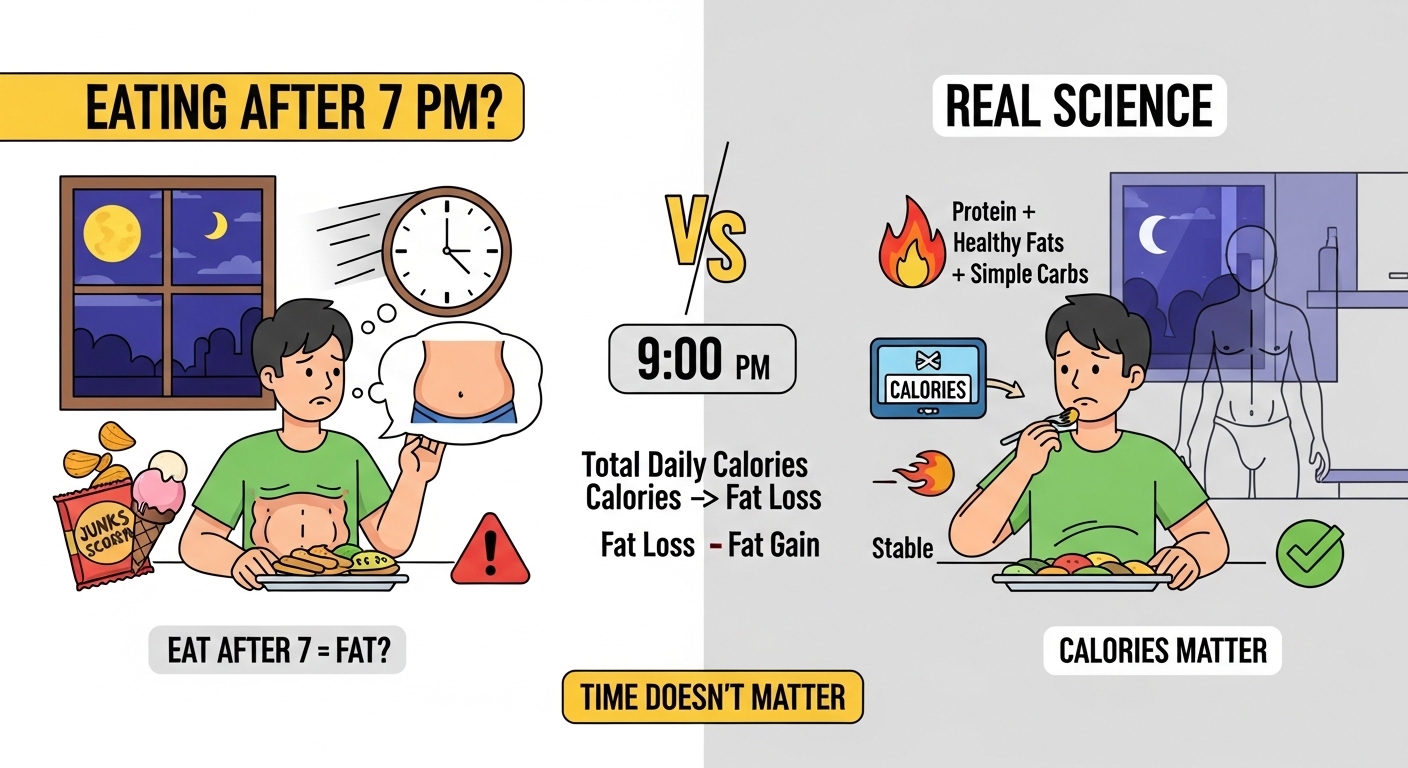

We’ve all heard the warning: “If you eat after 7:00 PM, your metabolism slows down and everything you eat turns straight into fat.”
It sounds like a logical biological “curfew,” but your body doesn’t actually have an internal clock that flips a “fat-storage switch” the moment the sun goes down. Your metabolism is a 24-hour furnace, not a shop that closes at sunset.
However, while the time might not matter for your math, it does matter for your behavior and your biology. Here is the no-BS breakdown of whether you should actually close the kitchen at 7:00 PM.
1. The Law of Thermodynamics Doesn’t Sleep
Calories don’t count for “more” just because it’s dark outside.
- The Math: If your body requires 2,500 calories a day to maintain its weight and you eat 2,000 calories, you will lose weight—regardless of whether those calories were eaten at 7:00 AM or 11:00 PM.
- The Reality: The “don’t eat after 7” rule works for most people simply because it accidentally creates a calorie deficit. Most “after-hours” eating isn’t chicken and broccoli; it’s chips, ice cream, and wine on the couch. By setting a cutoff, you’re just cutting out junk.
2. The “Insulin Sensitivity” Nuance
While total calories are king, your body is slightly less efficient at processing large amounts of carbohydrates late at night.
- The Science: Our bodies follow a Circadian Rhythm. As we get closer to sleep, our insulin sensitivity naturally decreases.
- The Strategy: A massive, carb-heavy feast at 10:00 PM might cause a larger blood sugar spike than the same meal at noon. If you are going to eat late, prioritize Protein and Healthy Fats to keep your blood sugar stable and your “fat-burning” environment intact.
3. The Sleep-Fat Loss Connection
This is the most “genuine” reason to avoid late-night eating. As we discussed in our sleep guide, fat loss is heavily dependent on the quality of your rest.
- The Problem: Digestion is an active, energy-intensive process. If you eat a heavy meal at 9:00 PM and go to bed at 10:00 PM, your body is busy “working” on your stomach instead of “repairing” your muscles and balancing your hormones.
- The Result: This can raise your core body temperature and disrupt deep sleep (REM), which leads to higher cortisol and lower growth hormone the next day—both of which stall fat loss.
The 7 PM Rule: Myth vs. Reality
| The Myth | The Logical Reality |
| Carbs turn to fat after 7 PM. | Total daily calories determine fat storage. |
| Your metabolism “stops” at night. | Metabolism remains active for vital functions. |
| Late eating causes weight gain. | Late-night snacking causes weight gain. |
| It’s “natural” to stop eating at dark. | Eating late disrupts Sleep Quality. |
4. The “Night Owl” Exception
What if you work the night shift? Or what if you hit a high-intensity workout at 8:00 PM?
- The Workout Factor: If you train late, you must eat afterward. Your muscles need amino acids and glycogen to begin the recovery process. Skipping a post-workout meal just because “it’s past 7:00” is a recipe for muscle loss and metabolic slowdown.
- The Logic: Your “nutritional window” should revolve around your activity, not the clock.
5. Environment Design: The “Kitchen Closed” Sign
If you struggle with emotional eating or boredom snacking, the 7:00 PM rule is a fantastic behavioral tool.
- The Fix: Treat “7:00 PM” as the end of your “feeding window.” Once the clock hits seven, you brush your teeth (as we recommended in our snacking guide) and the kitchen is “closed.” This provides a clear psychological boundary that prevents mindless grazing.
The Bottom Line
There is no “magic” in the hour of 7:00 PM. If you are eating high-quality food and staying within your calorie goals, you can eat at midnight and still lose fat.
However, for most people, stopping early improves sleep quality and reduces junk food intake. If you feel better and sleep better by stopping at 7:00 PM, do it. If your schedule requires you to eat at 9:00 PM, don’t sweat it—just keep the meal high-protein and manageable in size.