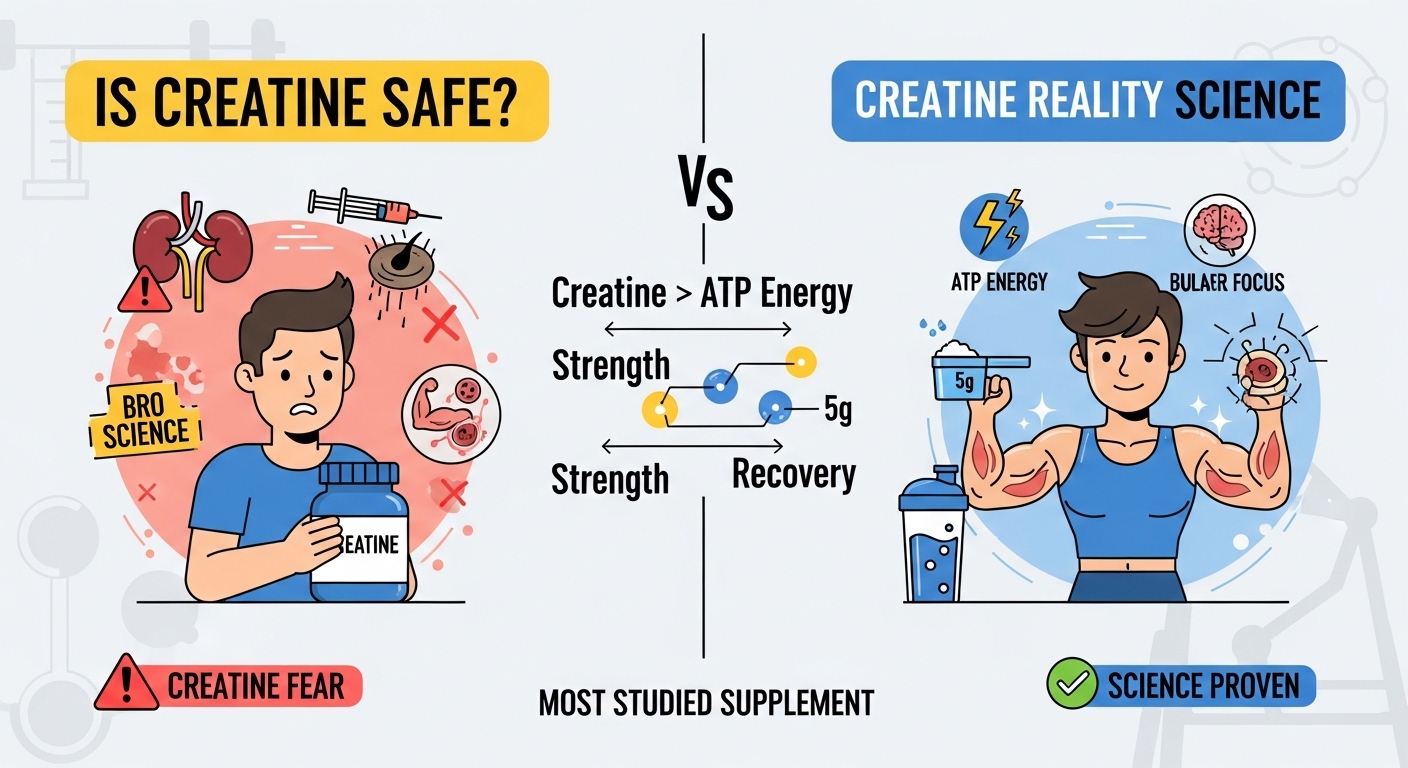

If you’ve spent five minutes in a gym, you’ve heard about creatine. You’ve also likely heard the rumors: “It damages your kidneys,” “It causes hair loss,” “It’s basically a steroid.”
Most of these claims are based on “bro-science” from thirty years ago that has been thoroughly debunked by hundreds of peer-reviewed studies. In the world of sports nutrition, creatine isn’t just “not harmful”—it’s arguably the most effective and safest supplement on the market.
Here is the no-BS logic on why your fear of creatine is misplaced.
1. What Is It? (It’s Not a Drug)
Creatine is a naturally occurring compound found in your muscle cells. It is made of three amino acids: Arginine, Glycine, and Methionine.
- The Logic: Your body already produces it, and you eat it every time you consume red meat or fish.
- The Function: It helps your muscles produce energy during heavy lifting or high-intensity exercise. It does this by increasing your stores of Phosphocreatine, which helps your body regenerate ATP (the primary energy currency of your cells).
2. The Kidney Myth: Understanding “Creatinine”
The biggest fear surrounding creatine is that it “hardens” or “stresses” the kidneys. This myth comes from a misunderstanding of a common blood test.
- The Science: A byproduct of creatine metabolism is creatinine. Doctors use creatinine levels as a marker for kidney function.
- The Confusion: If you supplement with creatine, your blood creatinine levels will naturally be slightly higher. This doesn’t mean your kidneys are damaged; it just means you have more “fuel” in your system.
- The Reality: For individuals with healthy, pre-existing kidney function, long-term studies have shown zero evidence of harm to the renal system.
3. Does It Cause Hair Loss?
This rumor started with a single 2009 study on rugby players that showed an increase in DHT (a hormone linked to hair loss).
- The Context: That study has never been replicated in over a decade of follow-up research.
- The Logic: There is currently no direct evidence that creatine causes hair loss. If you are genetically predisposed to male pattern baldness, DHT may play a role, but there is no proof that creatine accelerates that process for the average person.
4. The “Weight Gain” is Water, Not Fat
People often worry that creatine makes them “look bloated.”
- The Logic: Creatine is osmotically active. It pulls water into the muscle cell—not under the skin.
- The Benefit: This is called Cell Volumization. It actually makes your muscles look fuller and harder. It also creates a more anabolic environment for muscle repair. This “water weight” is functional, not aesthetic “fluff.”
Creatine: Fact vs. Fiction
| The Fear | The Biological Reality |
| “It’s a Steroid” | It’s a legal, non-hormonal amino acid compound. |
| “It Damages Kidneys” | Safe for healthy kidneys (elevates creatinine, not damage). |
| “It Causes Cramping” | Actually helps with hydration and recovery. |
| “You Must Load It” | 5g a day is sufficient; “loading” just gets you there faster. |
5. Beyond the Gym: The Cognitive Bonus
Recent research is moving away from the “muscle” benefits and into the brain.
- The Science: Your brain is a massive consumer of ATP. Studies show that creatine supplementation can improve short-term memory, reasoning, and mental fatigue, especially in vegetarians or those who are sleep-deprived.
The Bottom Line
Creatine monohydrate is safe, effective, and cheap. It is the only supplement that consistently delivers on the promise of increased strength and better recovery. Unless you have a pre-existing, serious kidney condition, there is no logical reason to avoid it.
The Simplified Rule: 5 grams of Creatine Monohydrate, every single day. No “cycles,” no “loading” required.