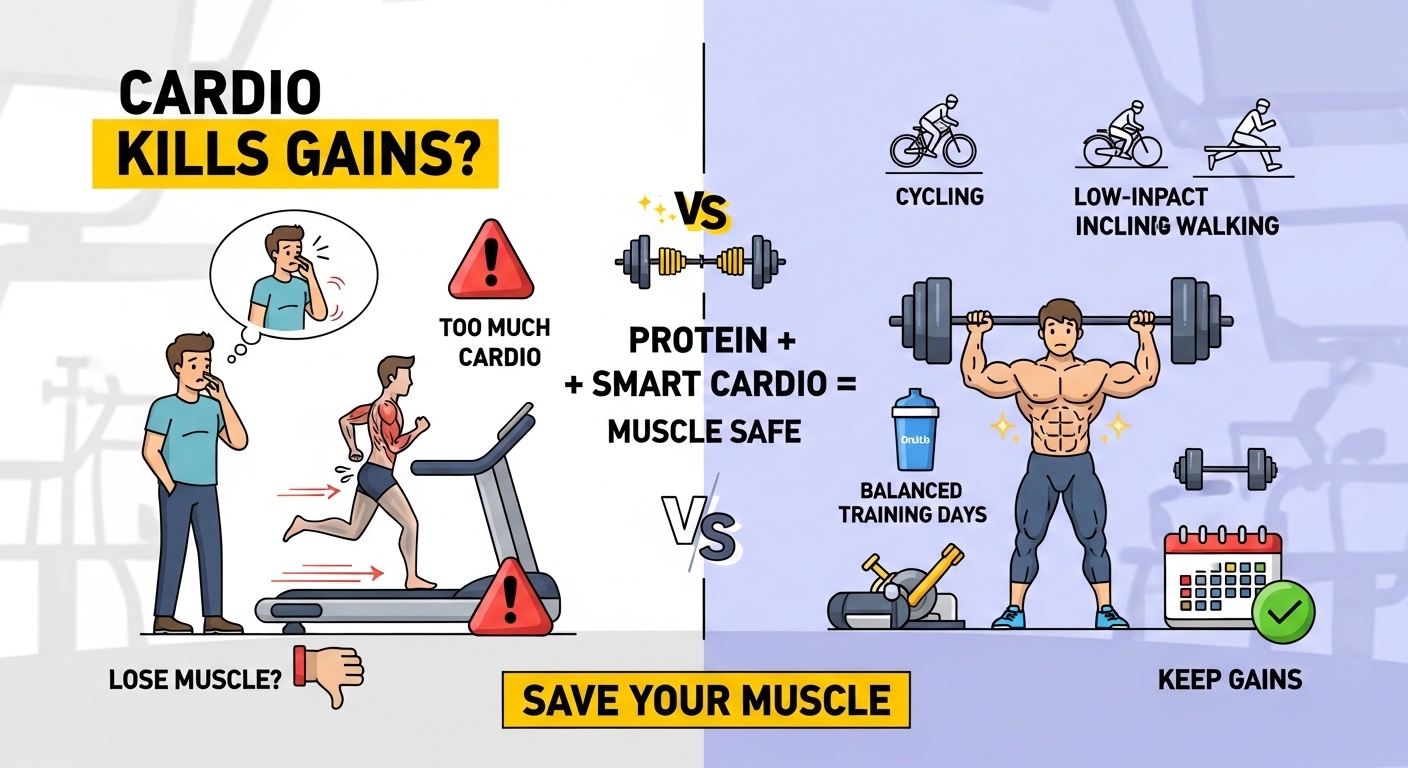

There is a long-standing image in the fitness world: the “skinny marathoner” vs. the “bulky bodybuilder.” This has led to the terrifying belief that if you step on a treadmill for more than ten minutes, your body will start “eating” your hard-earned muscle for fuel.
Is it possible for cardio to burn muscle? Yes. But it is much harder to do than you think. If you are training and eating correctly, cardio is actually a tool that can enhance your physique. Here is the no-BS logic on how to protect your gains while improving your heart.
1. The “Energy Shortage” Logic
Your body does not want to burn muscle. Muscle is functional; it’s what allows you to move and find food. Burning it for energy is a last-resort survival mechanism.
- The Reality: Muscle wasting (catabolism) typically only happens when you are in an extreme calorie deficit AND you are not providing a strength stimulus.
- The Fix: If you are lifting heavy weights and eating enough protein, your body receives a loud signal to keep the muscle. In this environment, cardio simply burns fat and glycogen.
2. The “Interference Effect” (AMPK vs. mTOR)
While cardio might not “burn” existing muscle, it can potentially “block” the growth of new muscle. This is known as the Interference Effect.
- The Science: Lifting weights activates mTOR, the pathway for growth. Intense or excessive cardio activates AMPK, the pathway for energy efficiency.
- The Conflict: These two pathways can sometimes act like a light switch—turning one on can dim the other.
- The Logic: If you do high-impact, high-volume cardio (like long-distance running) immediately before or after heavy lifting, the “endurance” signal can interfere with the “strength” signal.
3. The “Impact” Factor
Not all cardio is created equal when it comes to muscle preservation.
- Running: High-impact. Every stride causes eccentric muscle damage (the “tearing” sensation). This requires the same recovery resources as a leg day.
- Cycling/Swimming/Incline Walking: Low-impact. These involve very little eccentric damage.
- The Strategy: To save your muscle, choose concentric-based cardio. Cycling or rowing “flushes” the muscle with blood without causing the structural damage that interferes with recovery.
The Muscle-Safety Cheat Sheet
| Feature | Low Risk to Muscle | High Risk to Muscle |
| Activity | Incline Walking / Cycling | Sprints / Long-Distance Running |
| Duration | 20–30 Minutes | 60+ Minutes |
| Timing | After weights or on off-days | Before heavy lifting |
| Nutrition | High Protein / Calorie Control | Extreme Deficit / Low Protein |
4. The Recovery Drain
The most common way cardio “burns” muscle is indirectly—by stealing your recovery.
- The Logic: If you do a brutal HIIT session on Tuesday, you might be too fatigued to hit your Squat PR on Wednesday. If your strength drops, your muscle mass will eventually follow.
- The Solution: Treat cardio as a “accessory.” It should never be so intense that it lowers the numbers in your lifting log.
The Bottom Line
Cardio doesn’t “eat” muscle; poor recovery and low protein do. If you keep your cardio sessions moderate (30 minutes), choose low-impact options, and keep your strength levels rising, you can have a strong heart and big muscles at the same time.
Scientific Evidence & PubMed Studies
To understand the mechanics of the “Interference Effect” and muscle preservation, refer to these studies:
- The Interference Effect Defined: A landmark meta-analysis showing that while concurrent training (weights + cardio) can slightly limit power and explosive growth, it does not prevent hypertrophy (muscle size) if managed correctly.
- Molecular Signaling: This study explains the AMPK-mTOR “switch” and how the timing of your cardio can minimize the interference.
- Protein Sparing: Research showing that high protein intake ($1.6\text{g/kg}$ to $2.4\text{g/kg}$) prevents muscle loss even when adding aerobic exercise to a calorie deficit.
- Impact of Running vs. Cycling: This study found that cycling is significantly less “interfering” with muscle growth than running because it lacks the eccentric “damage” phase.