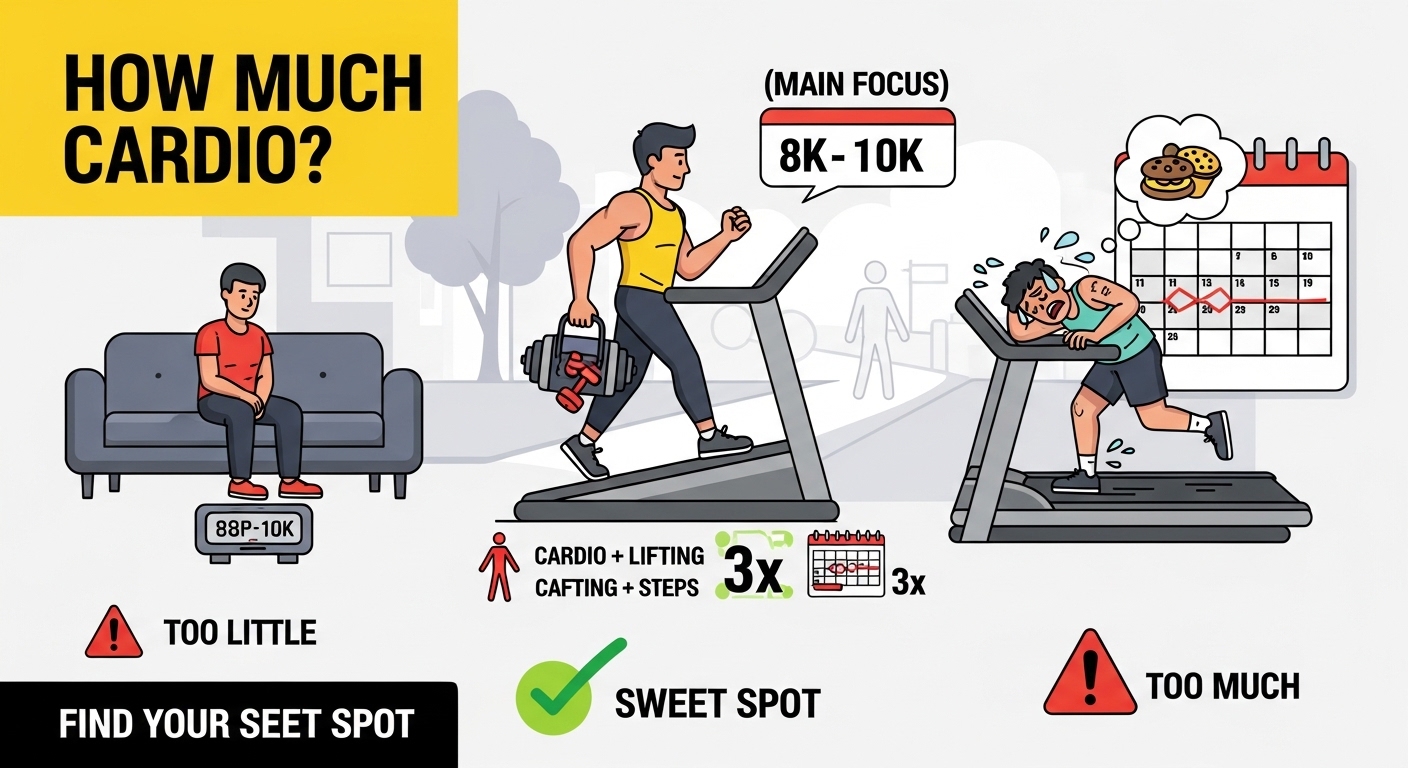

If you ask ten different trainers how much cardio you need, you’ll get ten different answers ranging from “none” to “two hours a day.”
The logic is simple: Fat loss requires a calorie deficit. Cardio is a tool to widen that deficit. However, there is a Point of Diminishing Returns where more cardio leads to increased hunger, muscle loss, and metabolic adaptation. Here is the no-BS guide to finding your ideal cardio “sweet spot.”
1. The “Basement” vs. The “Ceiling”
To stay healthy and lose fat efficiently, you need to stay within a specific range:
- The Basement (The Minimum): 150 minutes of moderate-intensity activity per week. This is the American Heart Association standard for cardiovascular health. If you do less than this, you are leaving health and metabolic benefits on the table.
- The Ceiling (The Maximum): Once your cardio duration exceeds your total time spent lifting weights (e.g., 6+ hours a week), you risk the “Interference Effect,” where your body begins to prioritize endurance over muscle preservation.
2. The “3-Tier” Fat Loss Protocol
Depending on your schedule and current fat-loss phase, choose the tier that fits your needs:
- Tier 1: The “Minimalist” (1-2 Days)
- Best for: Beginners or those in a deep calorie deficit.
- Volume: Two 20-30 minute sessions of LISS (Low-Intensity Steady State) per week.
- Tier 2: The “Sweet Spot” (3-4 Days)
- Best for: Most people looking for steady fat loss while maintaining muscle.
- Volume: Three 30-minute sessions per week.
- Tier 3: The “Finisher” (5+ Days)
- Best for: The final 4 weeks of a “shred” or those with a very high caloric intake.
- Volume: Daily 30-45 minute walks or light activity.
3. Why “NEAT” Outperforms Cardio
Before adding 40 minutes on the elliptical, you must address your NEAT (Non-Exercise Activity Thermogenesis). * The Logic: A 30-minute run burns ~300 calories. Walking 10,000 steps throughout the day burns ~400-500 calories.
- The Advantage: Walking doesn’t spike cortisol or cause the extreme “post-workout hunger” that high-intensity cardio does.
- The Simplified Rule: Hit 8,000-10,000 steps daily first. If you are still not losing fat, only then should you add “formal” cardio sessions.
Cardio Recommendation Table
| Activity Type | Goal | Recommended Weekly Volume |
| Walking (NEAT) | Baseline Fat Loss | Daily (8k – 10k steps) |
| LISS (Incline Walk/Cycle) | Caloric Burn | 90 – 150 Minutes |
| HIIT (Sprints/Rower) | Efficiency/Power | 30 – 45 Minutes (Max) |
The Bottom Line
Cardio is like salt: Use enough to flavor the fat loss, but use too much and you ruin the “dish” (your muscle and recovery). Aim for 3 sessions of 30 minutes a week alongside your lifting, and keep your daily step count high.
Are you currently doing cardio every day but the scale isn’t moving? Tell me your current step count and gym schedule, and I’ll help you rebalance your “Cardio-to-Lifting” ratio!
Scientific Evidence & Studies
- The “Goldilocks” Volume: A large-scale meta-analysis published in the British Journal of Sports Medicine suggests that 150–300 minutes of moderate-intensity activity is the “sweet spot” for long-term weight maintenance and metabolic health.
- The Interference Effect: Research in Sports Medicine highlights that excessive aerobic volume can inhibit the signaling pathways for muscle hypertrophy (mTOR), suggesting that “less is more” for those wanting a toned/muscular look.
- Cardio vs. NEAT for Fat Loss: This study shows that increasing non-exercise movement is often more sustainable and effective for preventing fat regain than structured “cardio” alone.