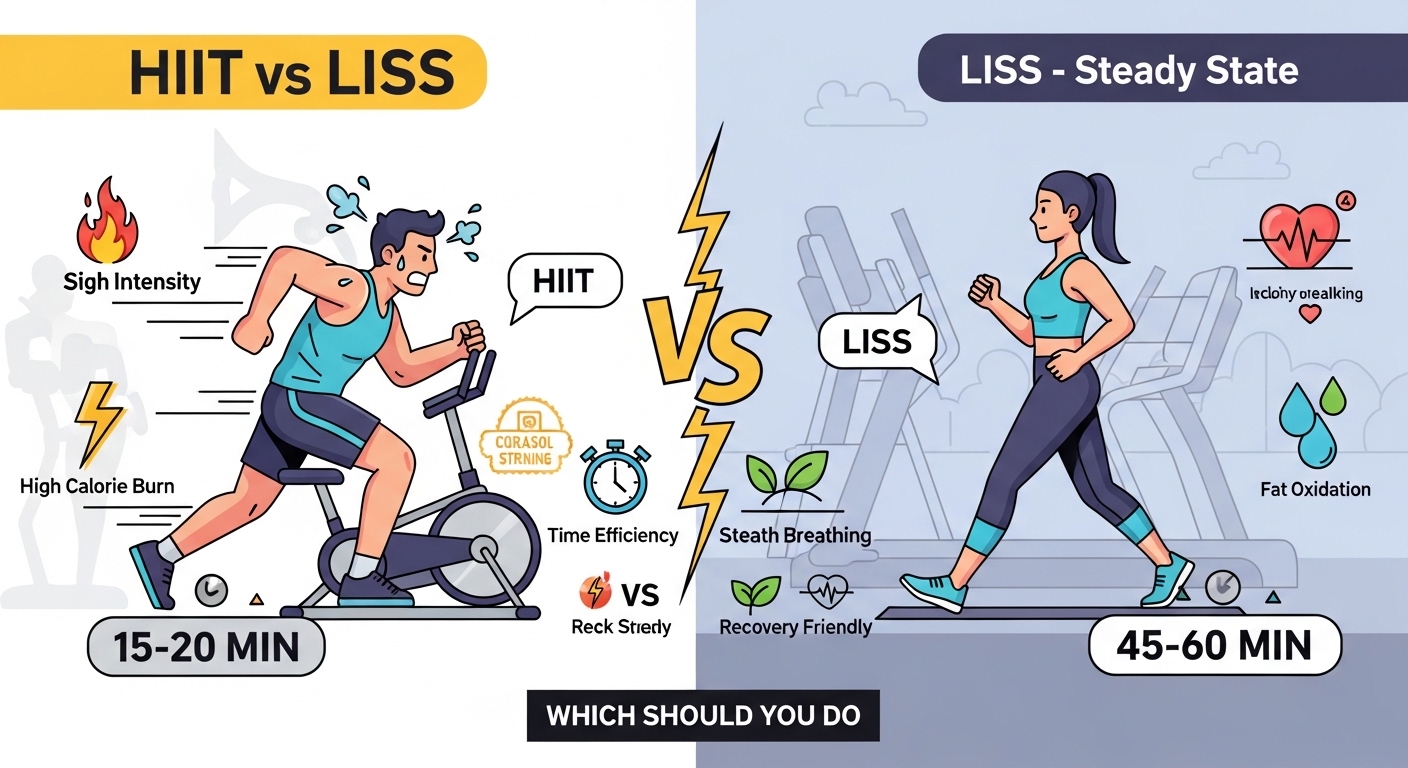

The fitness world loves a rivalry. In one corner, you have HIIT (High-Intensity Interval Training)—short, brutal bursts of maximum effort followed by rest. In the other, you have LISS (Low-Intensity Steady State)—the classic 45-minute jog or brisk walk.
Proponents of HIIT claim it “torches fat” in minutes, while the LISS crowd claims HIIT is too stressful on the central nervous system. The truth? Both are tools, but they serve different masters. Here is the logic-based breakdown of which one you should actually be doing.
1. The Time-Efficiency Equation
The primary “selling point” of HIIT is the Time-to-Results ratio.
- The Logic: Research shows that 20 minutes of HIIT can provide similar cardiovascular benefits and calorie burn to 50 minutes of steady-state cardio.
- The “Afterburn”: HIIT triggers a higher EPOC (Excess Post-exercise Oxygen Consumption). This means your metabolism stays slightly elevated for several hours after you leave the gym as your body works to return to its “resting” state ($homeostasis$).
2. The “Recovery Tax” (The HIIT Downside)
If HIIT is so efficient, why not do it every day? Because HIIT is a high-stress event.
- The Science: HIIT requires the body to tap into its “fight or flight” system (the sympathetic nervous system). This spikes Cortisol.
- The Conflict: If you are already doing heavy lifting 3–4 times a week, adding daily HIIT can lead to overtraining. You only have so much “recovery capital” to spend. If you spend it all on sprints, your squats will suffer.
- The LISS Advantage: Steady-state cardio is a “low-stress” event. It promotes blood flow and parasympathetic nervous system activity, which can actually help you recover from your lifting sessions rather than draining you further.
3. Fat Oxidation vs. Glucose Burning
Your body uses different fuel sources depending on intensity.
- HIIT is primarily glycolytic (it burns stored sugar/glycogen). It’s a high-power, fast-burning fuel.
- LISS is primarily oxidative (it burns a higher percentage of fat during the activity).
- The Reality: For total fat loss, the “source” of fuel during the workout matters less than the Total Calorie Deficit at the end of the day. However, for beginners, LISS is often “safer” because it doesn’t cause the same level of extreme hunger spikes that HIIT can trigger.
HIIT vs. LISS: The Comparison
| Feature | HIIT (Intervals) | LISS (Steady State) |
| Duration | 10–20 Minutes | 45–60 Minutes |
| Calorie Burn | High (Per minute) | Moderate (Per minute) |
| Impact on Joints | High | Low |
| Recovery Needs | 48–72 Hours | < 24 Hours |
| Primary Goal | Power / Efficiency | Recovery / Endurance |
4. The “Simplified” Recommendation
Which one is better? It depends on your Lifting Schedule.
- If you lift weights 4+ days a week: Stick to LISS (walking/hiking). It burns calories without interfering with your strength gains or recovery.
- If you only have 20 minutes twice a week: Do HIIT. It will provide the maximum cardiovascular “bang for your buck” in a short window.
Scientific Evidence and Studies
To help you decide, here are the peer-reviewed studies comparing these two modalities:
- Calorie Burn & Fat Loss: A 2017 meta-analysis published in Obesity Reviews found that both HIIT and LISS provide similar fat loss results, but HIIT does it with approximately 40% less time commitment.
- The EPOC Effect: This study quantifies the “Afterburn” and shows that while HIIT results in higher post-exercise oxygen consumption, the total calorie difference is often smaller than marketing suggests.
- Cardiovascular Health: Research in The Journal of Physiology shows that HIIT can improve insulin sensitivity and cardiovascular health as effectively as traditional endurance training, even with much lower total volume.
- Interference with Strength: This study explores how high-intensity “concurrent” training can potentially hinder muscle hypertrophy if recovery is not managed.
The Bottom Line
HIIT is a sprint; LISS is a stroll. If you are short on time and want to get “fit” fast, HIIT wins. If you want to protect your muscle gains and manage your stress levels, LISS is the superior tool.
Are you trying to “shred” for an event, or just looking to improve your heart health? Tell me your main goal, and I’ll tell you exactly how to program your cardio intervals!