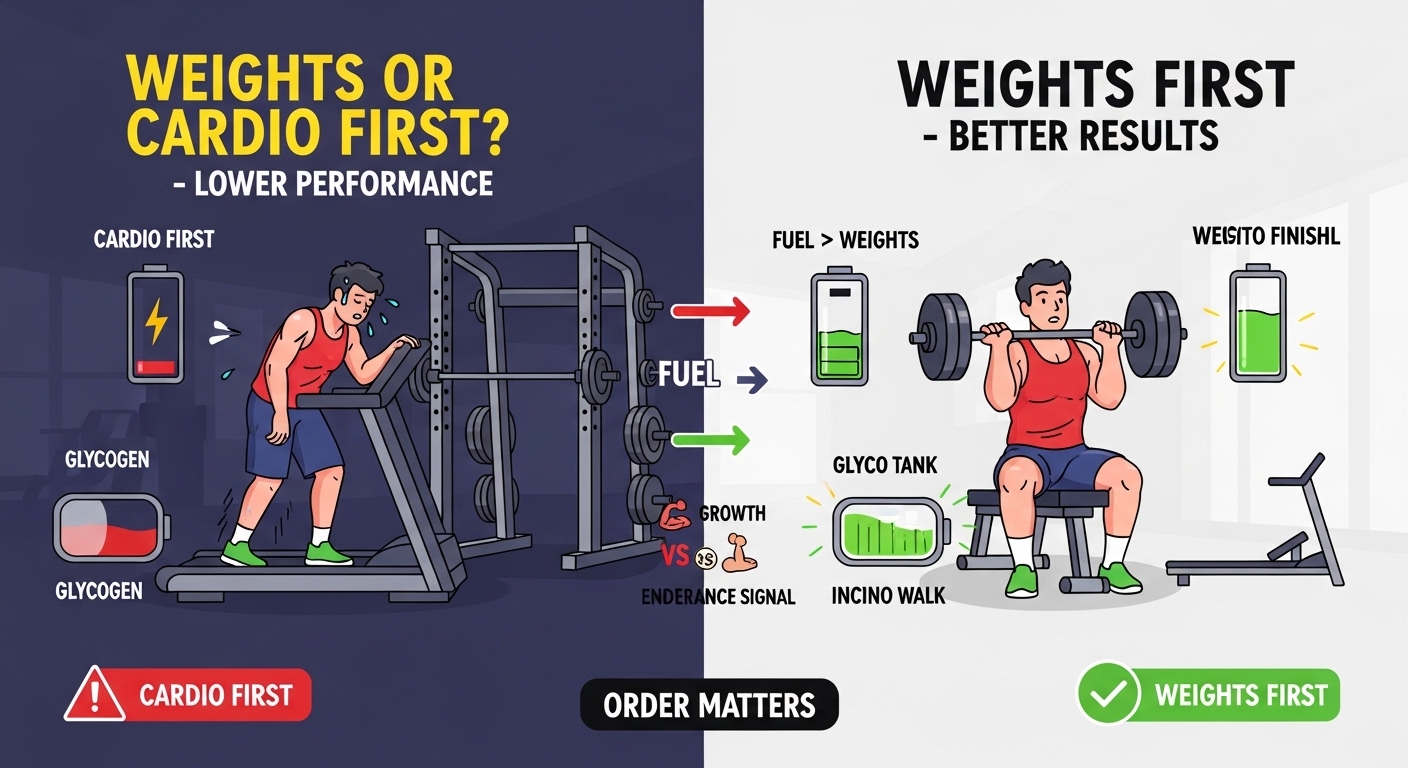

You walk into the gym with a limited battery of energy. You have roughly 45 to 60 minutes of high-intensity “fuel” (glycogen) stored in your muscles before performance begins to dip.
The question is: Where do you spend that fuel first? If your goal is to build muscle, lose fat, and look “toned,” the order in which you perform your sessions is not just a preference—it’s a biological decision. Here is the no-BS logic on why the sequence of your workout determines your results.
1. The Glycogen “Fuel Tank” Logic
Resistance training (lifting weights) is an anaerobic activity. It requires glucose (sugar) to be broken down quickly for explosive power.
- The Problem with Cardio First: If you do 30 minutes of steady-state cardio before you lift, you drain your muscle glycogen stores. When you finally reach the squat rack, your “fuel tank” is half-empty. You won’t be able to lift as heavy or with as much intensity.
- The Result: Less intensity means a weaker “signal” for muscle growth. You’ve sacrificed your strength gains for a few extra calories burned on the treadmill.
2. The “Interference Effect” (mTOR vs. AMPK)
Your body uses different signaling pathways to adapt to exercise.
- Lifting Weights triggers the mTOR pathway, which is responsible for protein synthesis and muscle growth.
- Cardio triggers the AMPK pathway, which is focused on energy efficiency and endurance.
- The Conflict: High-intensity cardio performed immediately before weights can “mute” the mTOR signal. By lifting first, you ensure the primary signal sent to your brain is: “Build more muscle.”
3. The Safety Factor
Lifting weights requires technical precision and core stability.
- The Fatigue Factor: If you are “gassed” from a 3-mile run, your stabilizing muscles (like your lower back and obliques) are fatigued. This is when form breaks down.
- The Logic: You want your nervous system to be fresh when you have a heavy bar on your back. Save the mindless movement (cardio) for the end when the risk of injury is lower.
The Priority Protocol: A Quick Guide
| Goal | Primary Focus | Optimal Sequence |
| Build Muscle / Tone | Strength | Weights First, Cardio After |
| Fat Loss | Calorie Deficit | Weights First, Cardio After |
| Marathon Training | Endurance | Cardio First, Weights After |
| General Health | Balance | Weights First, Cardio After |
4. The Fat Oxidation “Bonus”
There is a slight metabolic advantage to doing cardio after weights.
- The Logic: During a heavy lifting session, you burn through your blood glucose and muscle glycogen.
- The Result: When you step on the treadmill after lifting, your body is in a state where it is more likely to mobilize stored body fat for fuel, as the “easier” sugar sources have already been tapped.
5. The “Simplified” Exception
The only time you should do cardio before weights is a 5-minute dynamic warm-up.
- The Goal: A light jog or row for 5 minutes isn’t “cardio”—it’s a tool to increase core temperature and lubricate the joints. This is beneficial. Anything beyond 10 minutes starts to dip into your lifting performance.
The Bottom Line
Unless you are training specifically for an endurance race, lift weights first. Protect your strength, maximize your hormonal response, and use cardio at the end as a “finisher” to burn extra calories.
Scientific Evidence & Studies
To back up this logic, here are the peer-reviewed studies regarding the “Concurrent Training” effect:
- Muscle Strength and Hypertrophy: A systematic review and meta-analysis published in Sports Medicine found that doing cardio before strength training significantly reduced strength levels, whereas doing it after (or on separate days) maximized gains.
- The Interference Effect: This study explores how the molecular “signaling” (mTOR) is affected when cardio is introduced into a strength program.
- Energy Expenditure: Research in the Journal of Strength and Conditioning Research indicates that performing resistance exercise first leads to a greater “Afterburn” (EPOC) compared to the reverse.