
If you scroll through fitness social media, you’d think it was impossible to gain an ounce of muscle without a cabinet full of powders, pills, and pre-workouts.
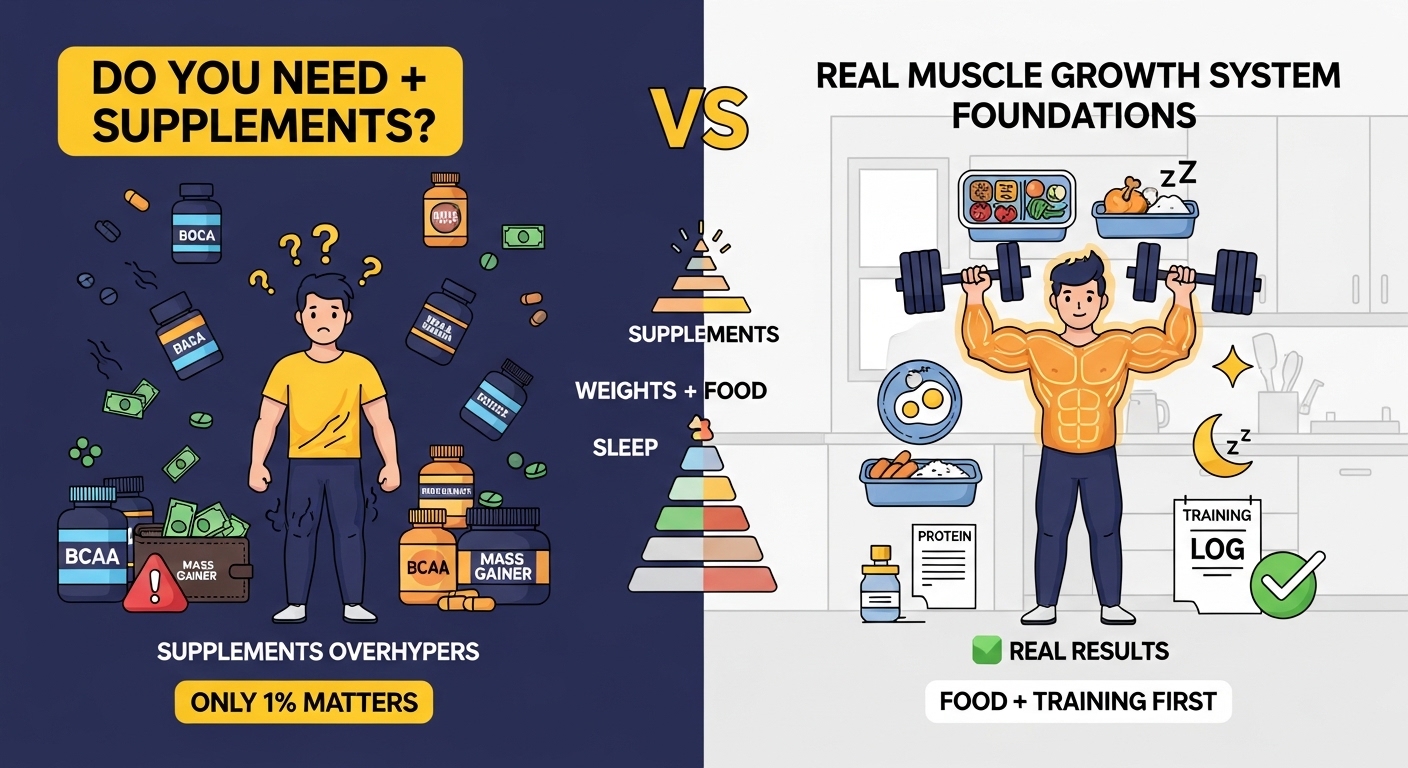
The supplement industry spends millions to make you believe that their products are the “secret” to growth. But here is the genuine, no-BS reality: Supplements are the 1% of the equation. If you have a broken diet and lazy training, a thousand dollars worth of supplements will do exactly zero for your physique.
Here is the logic-based breakdown of what you actually need to build muscle.
1. The Hierarchy of Hypertrophy
Think of building muscle like building a house.
- The Foundation: High-intensity resistance training (the “blueprint”).
- The Bricks: Total daily calories and protein (the “materials”).
- The Workers: Sleep and recovery (the “labor”).
- The Supplements: The fancy gold-plated doorbell on the front door.
The Logic: If you don’t have bricks or a blueprint, the gold-plated doorbell is useless. Supplements are designed to supplement a complete system, not replace it.
2. When Supplements Become “Logical”
While you don’t need them, some supplements are highly efficient tools for the high-intensity trainee. We categorize them by their Mechanical Benefit:
- Whey Protein: This is just food in powder form. It’s a tool for convenience. If you can’t eat enough chicken or eggs to hit your protein goal, a shake is a logical fix.
- Creatine Monohydrate: As we’ve discussed, this is the most researched supplement in history. It helps with ATP regeneration. It’s not “needed,” but it’s the only supplement that consistently provides a measurable 5–10% boost in strength.
- Caffeine: A simple tool for focus and intensity. If it helps you push 5% harder in the gym, it will result in more muscle growth over time.
3. The “Expensive Urine” List
There are several popular supplements that provide almost zero benefit if your diet is already on point:
- BCAAs (Branched-Chain Amino Acids): If you eat enough protein, you are already getting all the BCAAs you need. Drinking neon-colored BCAA water during your workout is essentially “expensive flavored water.”
- Testosterone Boosters: Most over-the-counter “boosters” are just herbal blends (like Tribulus) that have never been proven to increase muscle mass in healthy humans.
- Mass Gainers: These are usually just protein powder mixed with massive amounts of cheap sugar and maltodextrin. You’re better off eating a bowl of oats and peanut butter.
Muscle Growth: Source vs. Impact
| Growth Driver | Impact on Results | Source |
| Mechanical Tension | 60% | High-Intensity Lifting |
| Protein & Calories | 30% | Whole Foods (Meat, Eggs, Beans) |
| Sleep & Recovery | 9% | 7–9 Hours of Sleep |
| Supplements | 1% | Powders / Pills |
4. The “Placeholder” Trap
The biggest danger of supplements is the Psychological Crutch.
- The Error: Many people think, “I took my pre-workout and my BCAAs, so it’s okay if I only sleep 5 hours and eat junk today.”
- The Fix: You cannot “out-supplement” a lack of discipline. If you want to see results, focus 100% of your energy on your lifting log and your meal prep for the first 90 days before you even look at a supplement bottle.
5. The Safety and Purity Gap
Unlike food, supplements are not strictly regulated.
- The Risk: Many products contain “proprietary blends” or hidden fillers. If you choose to use supplements, look for Third-Party Testing (like Informed-Choice or NSF) to ensure that what is on the label is actually in the bottle.
The Bottom Line
Do you need supplements to build muscle? No. You need a calorie surplus, high protein intake, and a brutal commitment to getting stronger every week.
If you have the budget and your “system” is already running at 90% capacity, then adding Creatine and a quality Protein powder is a logical move. But if you’re looking for a “shortcut” in a bottle, save your money. The only thing that builds muscle is the work.