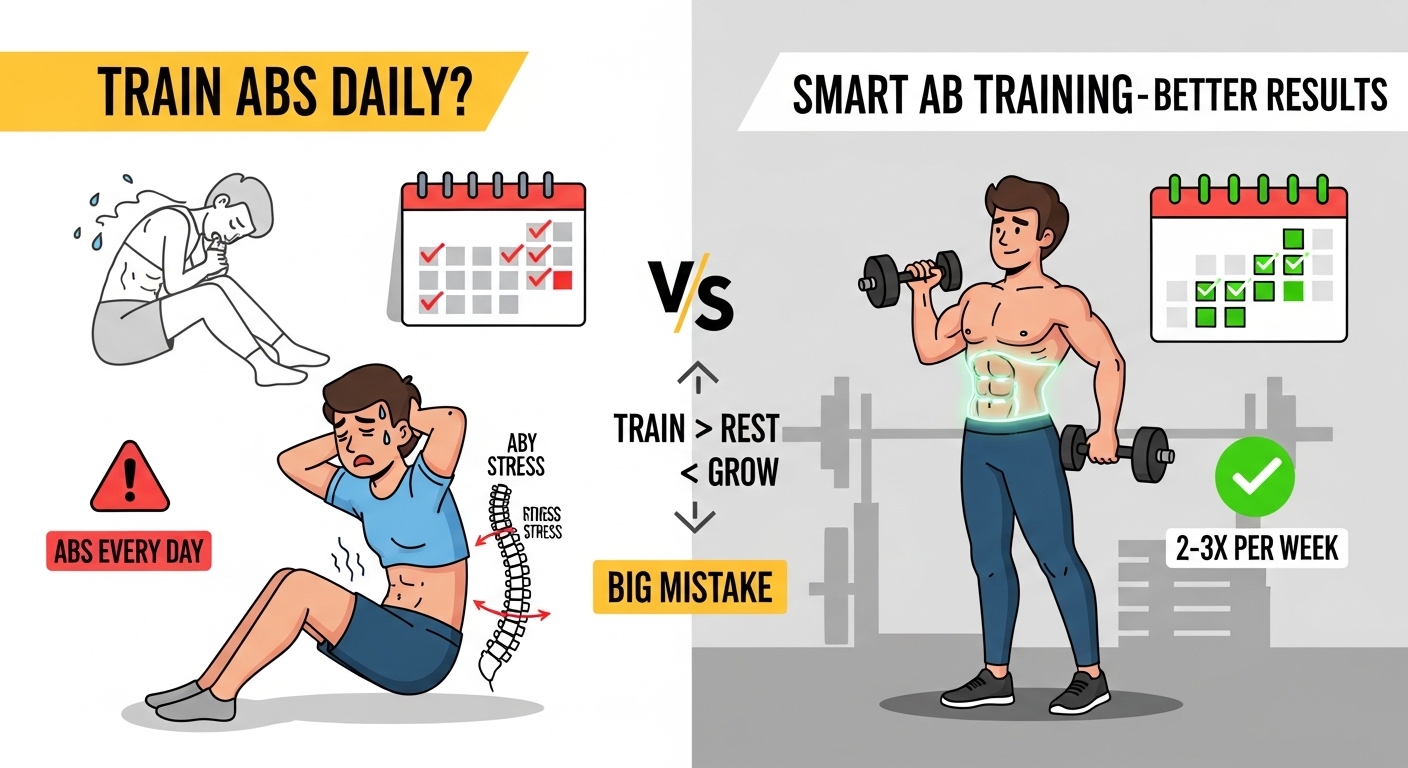

If you wanted bigger biceps, you wouldn’t do a thousand curls every single morning. You’d lift heavy, then let the muscle rest and grow.
Yet, for some reason, the abdominals are treated differently. People hit “ab day” every single morning, doing endless planks and sit-ups, thinking that more volume equals a flatter stomach. But the rectus abdominis is a muscle, not a magical entity. If you treat your abs like a cardio exercise rather than a strength exercise, you are stalling your progress.
Here is the no-BS logic on why “daily” is usually a mistake.
1. The Recovery Requirement
Muscles do not grow while you are working them; they grow while you are resting. * The Logic: When you train your abs with intensity, you create micro-tears in the muscle fibers. Your body needs 24–48 hours to repair those fibers, making them thicker and more defined.
- The Result: If you train them every day, you are constantly breaking them down before they have a chance to rebuild. This leads to “flat” looking muscles and poor core strength.
2. The “Spine Health” Threshold
Your core’s primary job is stability—protecting your spine from unnecessary movement.
- The Issue: Doing hundreds of daily spinal flexions (crunches) or rotations can put excessive wear and tear on your intervertebral discs.
- The Fix: Quality over quantity. Three sets of high-intensity, weighted cable crunches or “hollow body” holds twice a week will provide a much better “signal” for growth than daily, low-effort sit-ups.
3. The “Compound” Reality
If you are following a high-intensity program involving squats, deadlifts, or overhead presses, you are already training your abs.
- The Science: Your core must fire at near-maximum capacity to stabilize your spine during heavy compound lifts.
- The Math: If you do a heavy leg day on Monday, your abs are already fatigued. Hitting them again on Tuesday morning just prevents the recovery they need from the squats.
Daily Abs vs. Strategic Training
| Feature | Daily “Low-Intensity” Abs | 2-3x Weekly “High-Intensity” |
| Muscle Hypertrophy | Low (Muscles stay “thin”) | High (Abs become “pop”) |
| Recovery | Non-existent | Full (Optimal growth) |
| Spine Stress | Chronic / High | Targeted / Managed |
| Time Efficiency | Poor | Excellent |
4. The Visibility Myth (Again)
We have to repeat the “Simplified” truth: Doing abs daily will not burn belly fat.
- The Logic: You can have the strongest, most well-developed six-pack in the world, but if it is covered by a layer of fat, it will remain invisible.
- The Strategy: Use the time you would have spent on daily crunches to focus on Nutrition and Total Body Movement. That is what “reveals” the abs. Training them directly just makes them “pop” once the fat is gone.
5. When Should You Do Them?
There is one exception: Structural Stability.
- If you are doing very low-intensity “corrective” exercises (like “Dead Bugs” or “Bird-Dogs”) to fix back pain, doing them daily is fine because the intensity is too low to require a 48-hour recovery. But for aesthetic growth? Less is more.
The Bottom Line
Stop treating your abs like a ritual and start treating them like a muscle. Train them 2 to 3 times a week with high intensity (weights or difficult bodyweight progressions) and then leave them alone to grow.
If you want to see your abs, get your kitchen in order. If you want your abs to be impressive when they show up, give them time to recover.