
You’ve checked the boxes: Your calories are in a deficit, your protein is high, and you’re training with high intensity. But the scale isn’t moving, and you feel soft.
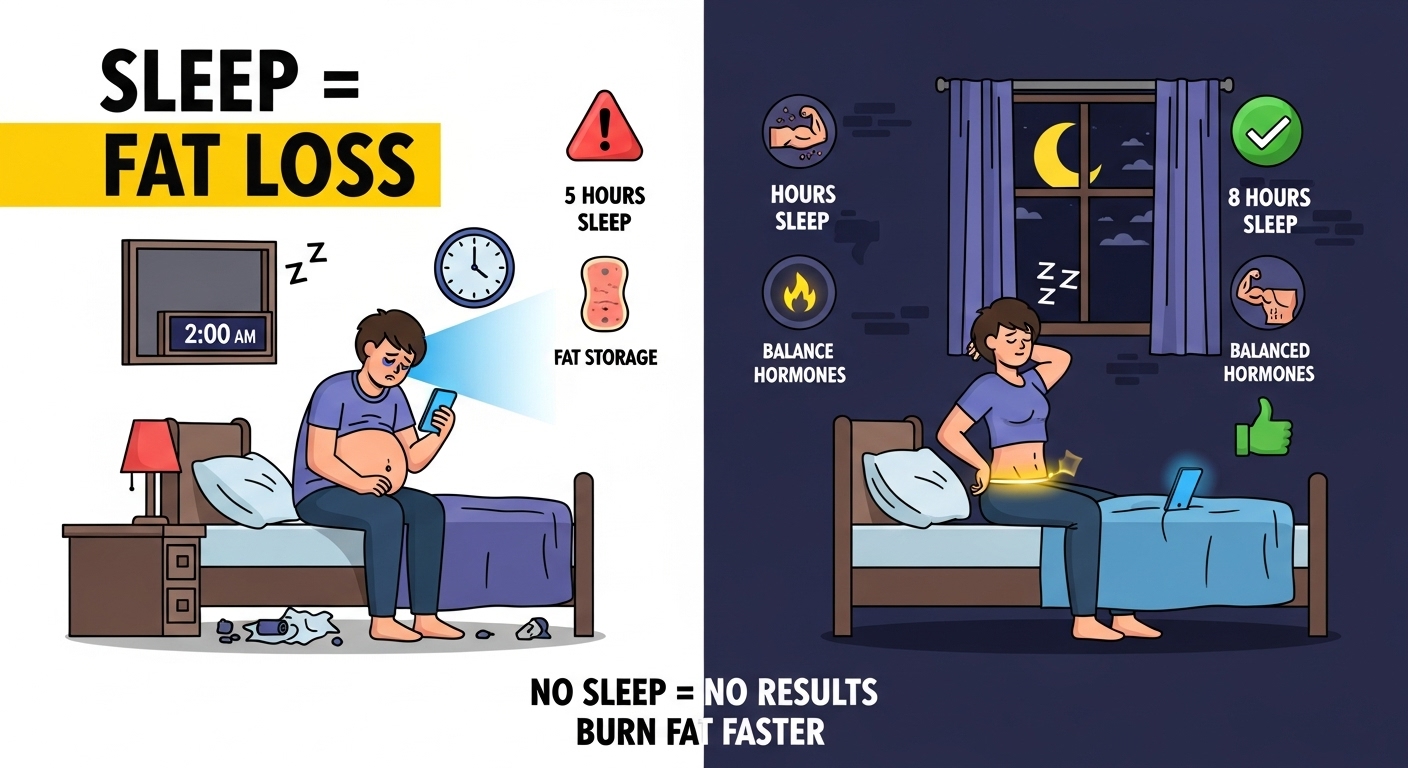
Most people treat sleep as a “lifestyle choice,” but in the context of fat loss, sleep is a metabolic requirement. If you are sleeping 5–6 hours a night, you are not just tired—you are biologically sabotaging your body’s ability to burn fat.
Here is the genuine, no-BS science of why your “system” fails when you skip sleep.
1. The Metabolic Switch: Fat vs. Muscle Loss
The most alarming study on this topic took two groups of people on the exact same calorie-restricted diet. One group slept 8.5 hours; the other slept 5.5 hours.
- The Result: Both groups lost the same amount of weight.
- The Catch: The well-rested group lost weight mostly from fat. The sleep-deprived group lost 55% less fat and significantly more lean muscle mass.
The Logic: When you are sleep-deprived, your body perceives a state of emergency. It becomes “stingy” with fat stores (your survival energy) and instead breaks down your metabolically expensive muscle tissue for fuel.
2. The Hunger Hormones: Leptin and Ghrelin
Weight loss isn’t just about willpower; it’s about hormone management. Sleep directly regulates two “hunger switches”:
- Ghrelin: The “Go” hormone. It tells you when to eat. After one night of poor sleep, ghrelin levels spike.
- Leptin: The “Stop” hormone. It tells your brain you are full. Sleep deprivation plummets your leptin levels.
The Reality: If you are underslept, you aren’t “weak” for wanting donuts; your brain is literally shouting at you to eat high-calorie junk because it’s searching for a quick hit of energy to keep you awake.
3. Cortisol and Insulin Resistance
Lack of sleep is a massive physiological stressor. This causes your Cortisol (stress hormone) to remain chronically elevated.
- The Fat Trap: High cortisol makes your cells Insulin Resistant. This means when you do eat, your body is more likely to shuttle those calories into fat storage rather than using them for muscle recovery.
- Water Retention: High cortisol also causes your body to hold onto excess water, leading to that “bloated” look that hides your progress in the mirror.
The Sleep-Deprived Fat Loss Trap
| Feature | 8+ Hours of Sleep | < 6 Hours of Sleep |
| Primary Weight Lost | Body Fat | Muscle Tissue |
| Hunger Levels | Controlled / Stable | High / Ravenous |
| Insulin Sensitivity | High (Efficient) | Low (Fat Storage Mode) |
| Workout Intensity | High Potential | Low (Weak Focus) |
4. The “Decision Fatigue” Factor
Fat loss requires a series of logical decisions. When you are sleep-deprived, the Prefrontal Cortex (the logical part of your brain) goes offline, and the Amygdala (the impulsive part) takes over. You are statistically more likely to skip your workout, order takeout, and rationalize poor choices when you are exhausted.
5. How to Optimize for Fat Loss
If you want to maximize your “inroad” into fat stores, you must prioritize these sleep non-negotiables:
- The 7-Hour Floor: Anything less than 7 hours is a metabolic compromise.
- The Cold/Dark Rule: Your core temperature must drop to initiate deep sleep. Keep your room at 18°C (65°F) and 100% dark.
- The “No Screen” Buffer: Blue light from your phone suppresses melatonin for up to 4 hours. Put the phone away 60 minutes before bed.
The Bottom Line
Sleep is not “laziness.” It is the time when your body balances its hormones, repairs muscle, and authorizes the burning of fat. You cannot out-train or out-diet a lack of sleep. If you want to see the results of your hard work in the gym, you have to give your body the time to execute those changes.
Scientific Evidence & PubMed Studies
1. The Muscle-Wasting Study (The 55% Gap)
This is the landmark study referenced in the post. Researchers at the University of Chicago found that when calories were restricted, sleep-deprived individuals lost the same weight but significantly less fat.
- The Science: Sleep deprivation shifted the metabolic energy source from fat oxidation to the breakdown of protein (muscle).
2. The Hormonal Hunger Switch (Leptin & Ghrelin)
Clinical research has consistently shown that short sleep duration is a potent stimulator of hunger. This study quantifies the decrease in leptin and the increase in ghrelin.
- The Science: A 19% decrease in leptin (satiety) and a 24% increase in ghrelin (appetite) were observed after just two nights of restricted sleep.
3. Cortisol and Insulin Sensitivity
Sleep restriction has been proven to cause a state of “peripheral insulin resistance.” This study shows that even four nights of poor sleep can make your fat cells 30% less sensitive to insulin—a metabolic age shift of nearly 10–20 years.
- The Science: Elevated evening cortisol levels disrupt the normal insulin response, making fat storage more likely.
4. Cognitive “Decision Fatigue”
Neuroimaging studies show that sleep deprivation leads to increased activity in the amygdala (the emotional, “junk food seeking” part of the brain) and decreased activity in the prefrontal cortex (the logical, “stick to the plan” part).
- The Science: Participants showed a significant preference for high-calorie, “reward” foods when underslept compared to when they were rested.