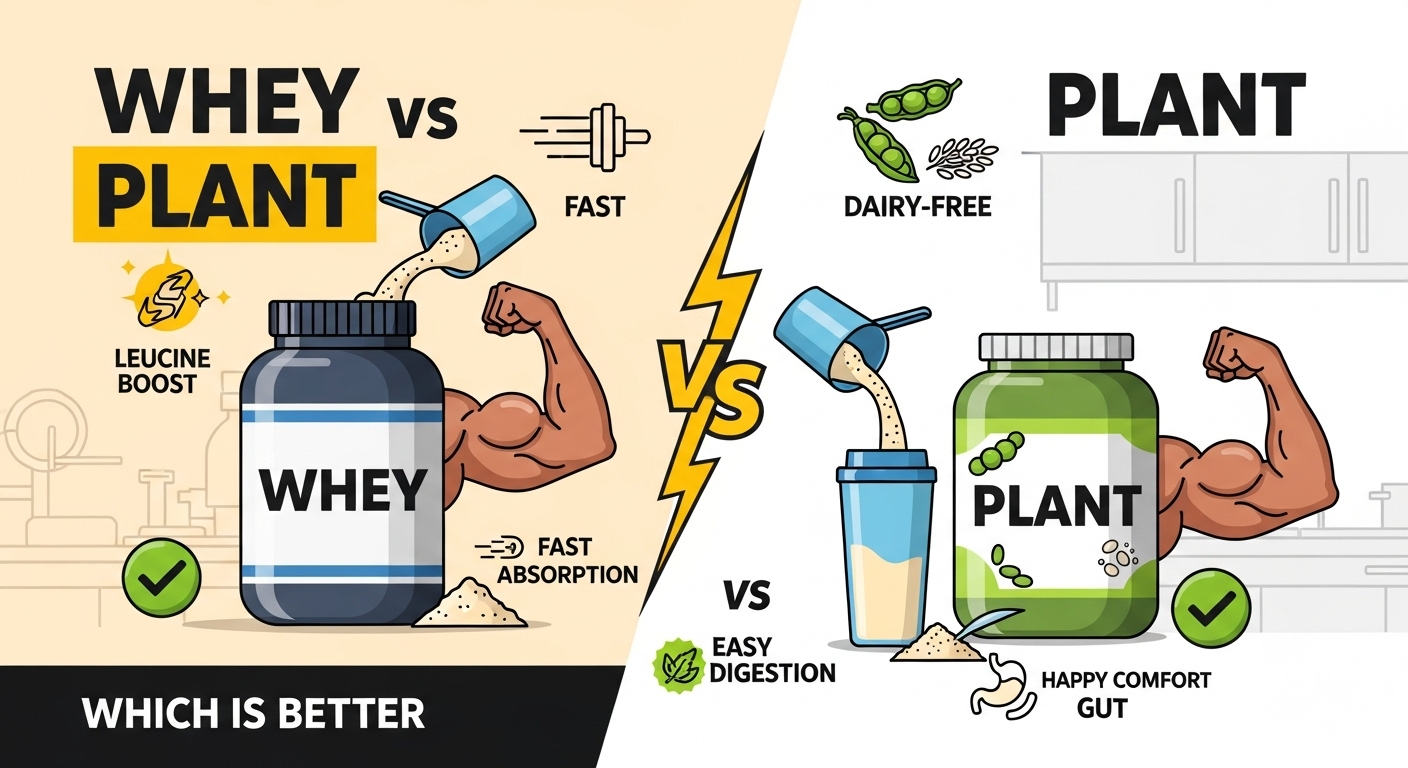

If you walk into any supplement store, you’ll see walls of colorful tubs all claiming to be the “ultimate” muscle builder. In one corner, you have Whey, the long-reigning king of bodybuilding. In the other, you have the rapidly growing world of Plant Proteins (Pea, Rice, Hemp, and Soy).
Is one objectively “better” for your physique, or is it all just marketing?
If we strip away the branding and look at the raw biology, the answer becomes clear. Here is the logic-based breakdown of the great protein debate.
1. The Amino Acid Profile (The Blueprint)
Your body doesn’t actually need “protein”; it needs the amino acids that make up that protein. Specifically, it needs the nine essential amino acids (EAAs) that it cannot produce on its own.
- Whey Protein: This is a “complete” protein. It contains all the EAAs in perfect proportions for human muscle growth. Most importantly, it is incredibly high in Leucine, the “anabolic trigger” that tells your body to start building muscle tissue.
- Plant Protein: Most plant sources (like pea or rice) are “incomplete” on their own—they are often low in one or two specific amino acids. To get the same muscle-building signal as whey, plant proteins must be “blended” (e.g., Pea + Rice) to create a complete profile.
2. Bioavailability: How Much Do You Actually Use?
Not all protein you swallow ends up in your muscles. The Biological Value (BV) measures how efficiently your body utilizes the protein you consume.
- Whey: Has one of the highest BVs of any food source (around 104). It is absorbed almost entirely and very rapidly.
- Plant: Generally has a lower BV. Because plant proteins are often bound to fiber or other “anti-nutrients,” your body may only absorb 60–80% of what is on the label.
The Logic: If you choose plant protein, you likely need to scoop 20–30% more to get the same effective dose of amino acids as a single scoop of whey.
3. Digestion and “The Bloat”
This is the area where personal biology trumps general science.
- The Whey Issue: Whey is derived from dairy. Even “Isolate” versions (which have the lactose removed) can cause bloating or skin issues for those with sensitivities to milk proteins (casein or whey).
- The Plant Advantage: For those with dairy sensitivities, plant protein (specifically Pea or Soy) is often much easier on the digestive tract. A muscle can’t grow if your gut is in a constant state of inflammation.
Comparison at a Glance
| Feature | Whey Protein Isolate | Plant Protein Blend |
| Muscle Growth Trigger | Elite (High Leucine) | Good (if blended) |
| Digestion Speed | Rapid | Moderate |
| Purity | High Protein / Low Carb | Varies (often higher carb) |
| Dairy-Free? | No | Yes |
| Biological Value | 104+ | 60–80 |
4. The Verdict: Which Should You Buy?
In the context of High-Intensity Training, we want the most efficient “inroad” into recovery.
- Choose Whey If: You have no issues with dairy and want the absolute most “bang for your buck” in terms of muscle protein synthesis. It is the gold standard for a reason: it triggers growth faster and more effectively per gram than any other source.
- Choose Plant If: You are vegan, have a dairy allergy, or find that whey makes you feel lethargic or bloated. A high-quality Pea/Rice blend or Soy Isolate will still get the job done, provided you are hitting your total daily protein goals.
The Bottom Line
From a strictly biological standpoint, Whey Isolate is the superior muscle-building tool due to its amino acid density and absorption rate. However, the “best” protein is the one you can consume consistently without digestive distress.
If you choose plant-based, just remember the “1.2x Rule”: eat slightly more to make up for the lower bioavailability.
Scientific Evidence & PubMed Studies
1. The Leucine Threshold and Anabolic Signaling
Muscle Protein Synthesis (MPS) is largely governed by the “Leucine Trigger.” Research shows that whey typically reaches this threshold faster than plant sources due to its higher concentration of this specific amino acid.
- The Science: Whey protein contains about 10–12% Leucine, while most plant sources hover around 6–8%. This study explores how the leucine content of a protein source determines the magnitude of the muscle-building response.
2. Bioavailability and the DIAAS Score
The “Biological Value” mentioned in the post is often measured clinically via the Digestible Indispensable Amino Acid Score (DIAAS). This is the modern gold standard for determining protein quality.
- The Science: This study compares animal vs. plant proteins and consistently ranks whey as having a “superior” score (often >1.0) compared to isolated plant sources like peas or wheat, which often fall below 0.8.
3. The “1.2x Rule” (Dose-Response)
Research suggests that plant protein can be just as effective as whey, provided the dose is high enough to overcome the lower leucine content and lower bioavailability.
- The Science: A 2021 study found no difference in muscle mass or strength gains between a vegan diet and an omnivorous diet when protein intake was high ($1.6\text{g/kg}$).
4. Digestion and Insulin Response
While whey is superior for speed, it also elicits a higher insulin response than many plant proteins. This can be beneficial post-workout but may be a factor for those managing specific metabolic conditions.
- The Science: This study examines the insulinotropic effects of whey protein compared to other sources.