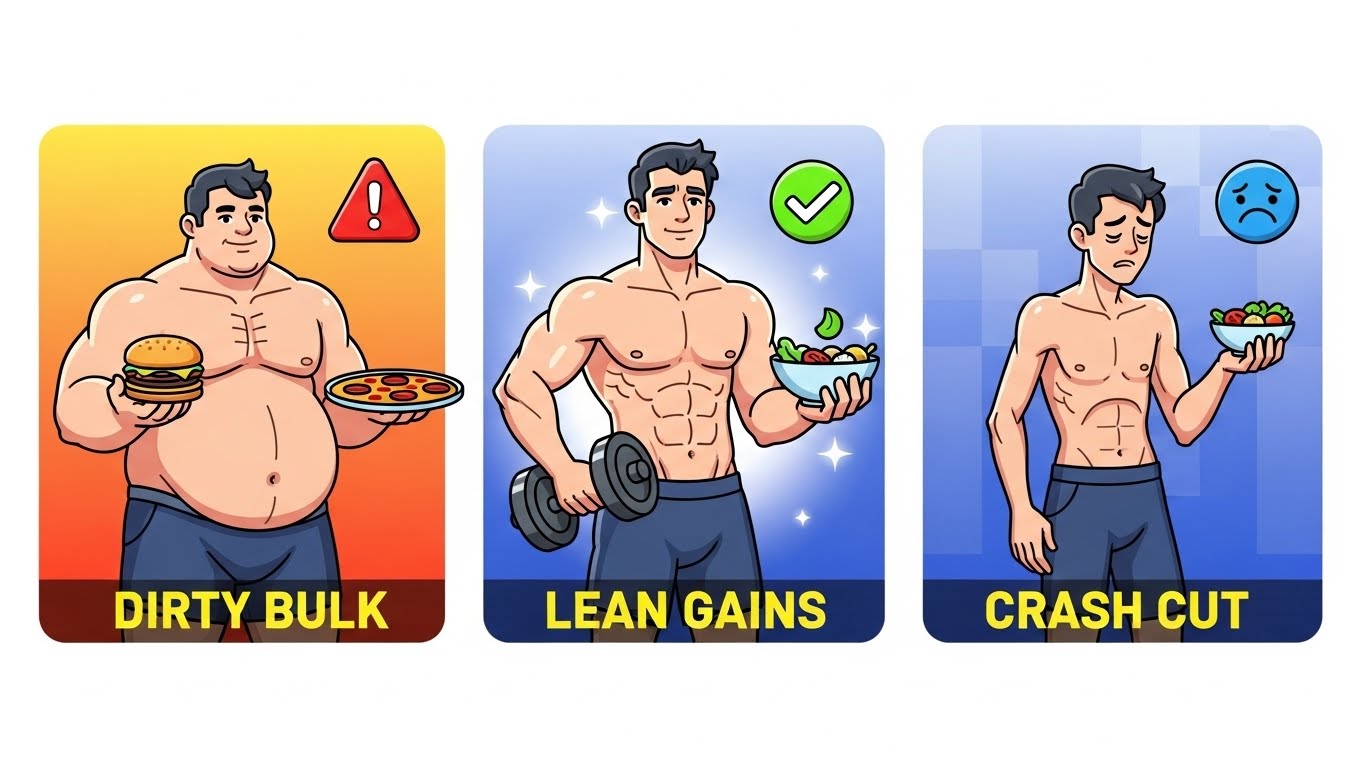

In the world of physical culture, we are constantly bombarded with two conflicting dogmas. On one hand, the “Bulk”—the idea that you must eat everything in sight to grow. On the other, the “Cut”—the process of starving oneself into a state of lean definition.
But if we apply reason and biological fact, we find that most people are approaching this choice with a fundamental misunderstanding of how the human body functions.
The question isn’t “which is better.” The question is: What is the most efficient way to achieve a muscular, lean physique without wasting your time?
1. The Fallacy of the “Dirty Bulk”
The idea that “more food equals more muscle” is one of the most persistent and damaging myths in fitness. Muscle growth is a physiologically limited process. Your body has a specific, fixed capacity for synthesizing new protein into muscle tissue.
If your body can only build 0.5 pounds of muscle in a week, eating enough food to gain 5 pounds in that same week will not accelerate the process. It will simply result in 0.5 pounds of muscle and 4.5 pounds of useless, health-destroying adipose tissue (fat). * The Logical Conclusion: A “bulk” that makes you fat is not a muscle-building strategy; it is an exercise in gluttony that forces you to spend months dieting later, often losing your hard-earned muscle in the process.
2. The Myth of “Cutting” for Beginners
Conversely, many beginners start a “cut” before they have any foundational muscle to reveal. If you have not yet triggered the biological necessity for growth through high-intensity training, “cutting” will simply leave you looking frail and emaciated.
You cannot “carve” a statue out of a pebble. You must first create the mass through intense, brief, and infrequent stimulation before you worry about the fine details of definition.
3. The “Third Way”: Lean Gains (The Rational Surplus)
The most efficient way to transform is to provide the body with exactly what it needs and nothing more. To build muscle, you need a “slight” energy surplus—just enough to fuel the recovery and repair process triggered by your heavy, high-intensity workouts.
- The Requirement: A surplus of 200 to 300 calories above maintenance is often the biological limit of what the body can actually utilize for growth.
- The Benefit: By staying lean while you grow, your hormonal profile (insulin sensitivity and testosterone) remains optimized for muscle building rather than fat storage.
4. How to Choose Your Starting Point
If you are currently standing at the crossroads, use this logical filter to decide your path:
| If your Body Fat is… | Your Logical Priority is… |
| Above 20% (Men) / 28% (Women) | A Targeted Deficit. Excess fat creates an inflammatory environment that hinders muscle growth. Get lean first. |
| 10% to 15% (Men) / 18% to 23% (Women) | A Rational Surplus. You are in the hormonal “sweet spot.” Train with maximum intensity and eat slightly above maintenance. |
| Below 10% (Men) / 18% (Women) | Growth. Your body is primed. Provide the nutrients, trigger the intensity, and get out of the gym to let it grow. |
5. The Intensity Connection
Whether you are in a deficit or a surplus, the intensity of your training must remain absolute. Many people “train light” while cutting, which is a death sentence for muscle tissue.
When calories are low, you must give your body an even stronger reason to keep its muscle. You must train to absolute muscular failure to signal that the muscle is vital for survival. If you don’t use it, and you don’t provide the energy to keep it, your body will gladly get rid of it.
The Bottom Line
The “Bulk vs. Cut” cycle is often a treadmill to nowhere. The most productive approach is to stay within a “striking distance” of being lean year-round.
Stop “bulking” until you’re fat, and stop “cutting” until you’re weak. Focus on the singular goal of increasing your strength through high-intensity effort, provide a modest surplus of high-quality nutrients, and let the biological laws of the universe do the rest.