
There is nothing more discouraging than waking up with a flat stomach, hitting a great workout, and then ending the day looking six months pregnant.
Most “health” influencers will tell you to buy a waist trainer or drink a “detox” juice. Both are useless. Bloating isn’t a mystery; it is a physical accumulation of either gas or fluid in the digestive tract. To fix it, you have to understand the mechanics of why your “system” is backed up.
Here is the genuine, no-BS guide to reducing bloat and reclaiming your midsection.
1. The Fiber Paradox
We are told to eat more fiber for “health,” but for many, a sudden increase in fiber is the primary cause of bloating.
- The Logic: Fiber is indigestible. When it reaches your large intestine, your gut bacteria ferment it. A byproduct of fermentation is gas (CO2, methane, and hydrogen).
- The Fix: If you’ve recently increased your intake of broccoli, beans, or oats, your gut bacteria may be overwhelmed. Scale back. Reintroduce fiber slowly in 5g increments per week to allow your microbiome to adapt without the gas buildup.
2. Low-Acidity and “The Splash”
If your stomach acid (HCL) is too low, food—especially protein—doesn’t break down properly before entering the small intestine. This is called Hypochlorhydria.
- The Result: Partially digested food sits in the gut longer, attracting bacteria that cause fermentation and “upper” bloating (right under the ribs).
- The Fix: Try a tablespoon of Apple Cider Vinegar in water 10 minutes before a large meal. This lower pH environment assists your natural enzymes in breaking down tough protein structures.
3. The “Air Gulping” (Aerophagia)
You can literally “eat” air. This has nothing to do with what you eat, but how you eat.
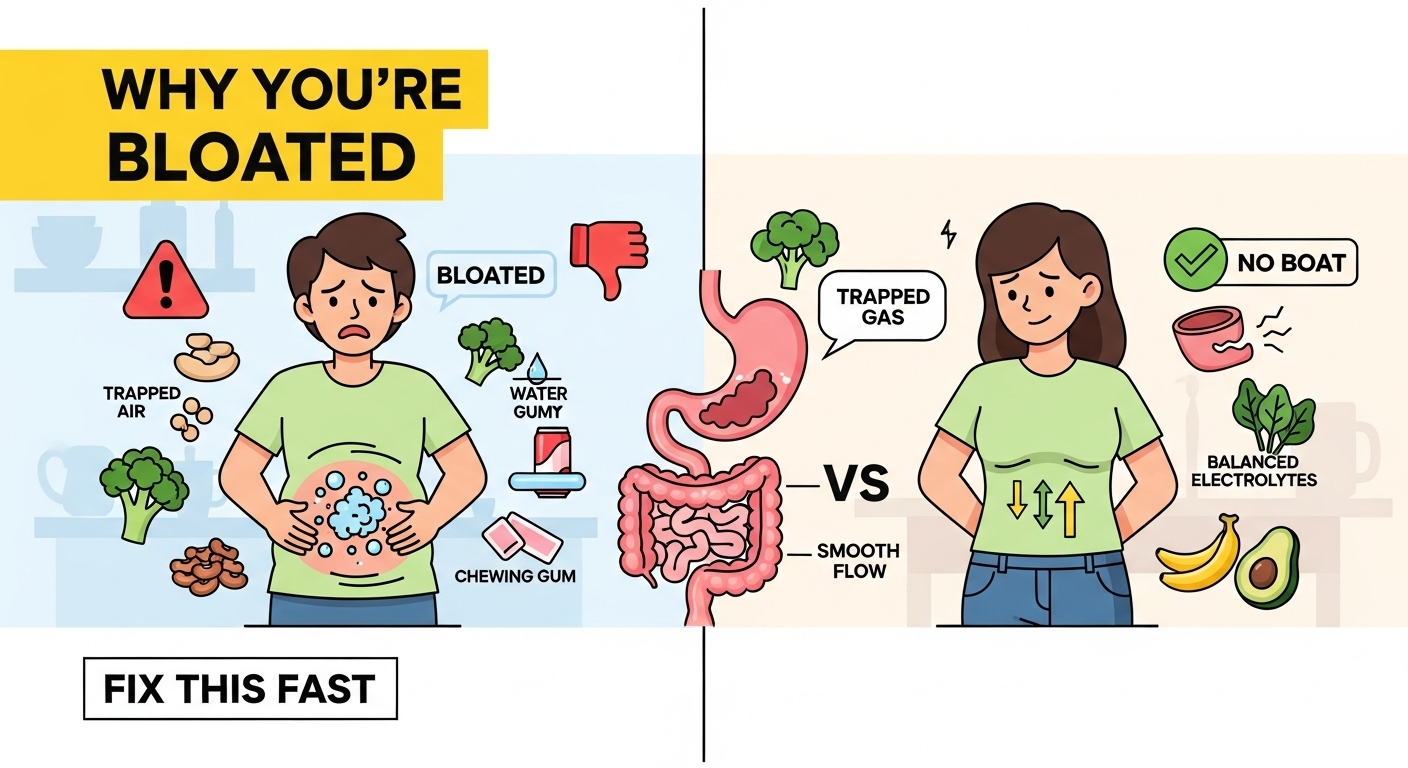
- The Culprits: Chewing gum, drinking through straws, and talking while eating.
- The Fix: Slow down. In line with our Fitness Simplified philosophy, treat eating as a dedicated task. Chew your food until it is a liquid paste. Digestion starts in the mouth with salivary amylase; if you skip this step, you’re forcing your gut to do double the work.
4. Sodium and the “Water Shift”
Not all bloating is gas. Sometimes it’s interstitial fluid retention.
- The Logic: Sodium pulls water outside of your cells. If you have a high-sodium meal without enough Potassium to balance it, your body holds a layer of water between your skin and muscle.
- The Fix: Balance your electrolytes. If you had a salty meal, don’t just drink water (which can sometimes make the “soft” look worse); eat high-potassium foods like spinach or avocado to shift the water back into the muscle cells where it belongs.
The Bloat-Check: Common Culprits
| Food/Habit | Why it Bloats You | The Simplified Swap |
| Sugar Alcohols | Erythritol/Xylitol ferment in the gut. | Stevia or Monk Fruit. |
| Raw Cruciferous | Hard-to-break-down cellulose. | Steamed or Sautéed veggies. |
| Carbonated Drinks | You are literally swallowing gas. | Still water with lemon. |
| Chronic Stress | Shuts down the “Rest & Digest” system. | 5 deep breaths before eating. |
5. Identify Your “Hidden” Intolerances
You don’t need a fancy $300 blood test. Most bloating is caused by a sensitivity to FODMAPs (Fermentable Oligosaccharides, Disaccharides, Monosaccharides, and Polyols). These are short-chain carbs that some people simply cannot absorb.
- Common Triggers: Garlic, onions, and wheat.
- The Strategy: Try an elimination diet for 3 days. Cut out the “Big Three” (Dairy, Gluten, and Alliums). If your bloat vanishes, you’ve found your culprit.
The Bottom Line
Bloating is a signal that your digestive system is struggling to keep up with the load you’ve given it. Stop looking for a “magic tea.” Instead, focus on chewing your food, managing your fiber intake, and balancing your electrolytes. When your internal “plumbing” is efficient, the bloating disappears.
Scientific Evidence & PubMed Studies
1. The Fiber and Fermentation Link
Research confirms that while fiber is essential, high-fiber diets—particularly those high in “insoluble” fiber—increase gas production through colonic fermentation. This study highlights the relationship between fiber intake and abdominal pressure.
- The Science: Excessive fiber can lead to “mechanical” bloating when the microbiome is not yet conditioned to the load.
2. Hypochlorhydria (Low Stomach Acid) and Digestion
The role of gastric acid in protein denaturation is well-documented. When $HCl$ levels are insufficient, the body cannot effectively activate pepsin, leading to the “backlog” and fermentation described in the post.
- The Science: This study discusses how impaired gastric acid secretion leads to bacterial overgrowth and malabsorption.
3. Aerophagia (Air Swallowing)
Clinical studies on functional dyspepsia often point to Aerophagia—the involuntary swallowing of air—as a leading cause of gastric distension.
- The Science: Habits like gum chewing and rapid eating are statistically linked to increased intestinal gas volume.
4. Sodium-Potassium Balance (The “Water Shift”)
The Sodium-Potassium Pump ($Na^+/K^+-ATPase$) is a fundamental biological mechanism. This research explains how high sodium intake increases extracellular fluid volume, leading to the “soft” bloated look.
- The Science: Potassium acts as the physiological antagonist to sodium, helping to excrete excess fluid via the kidneys.
5. FODMAPs and Short-Chain Carbohydrates
The Low-FODMAP Diet is the clinical gold standard for managing bloating. This meta-analysis proves that reducing these fermentable carbs significantly reduces abdominal distension and gas.
- The Science: Short-chain carbohydrates pull water into the small intestine and are rapidly fermented by bacteria in the large intestine.