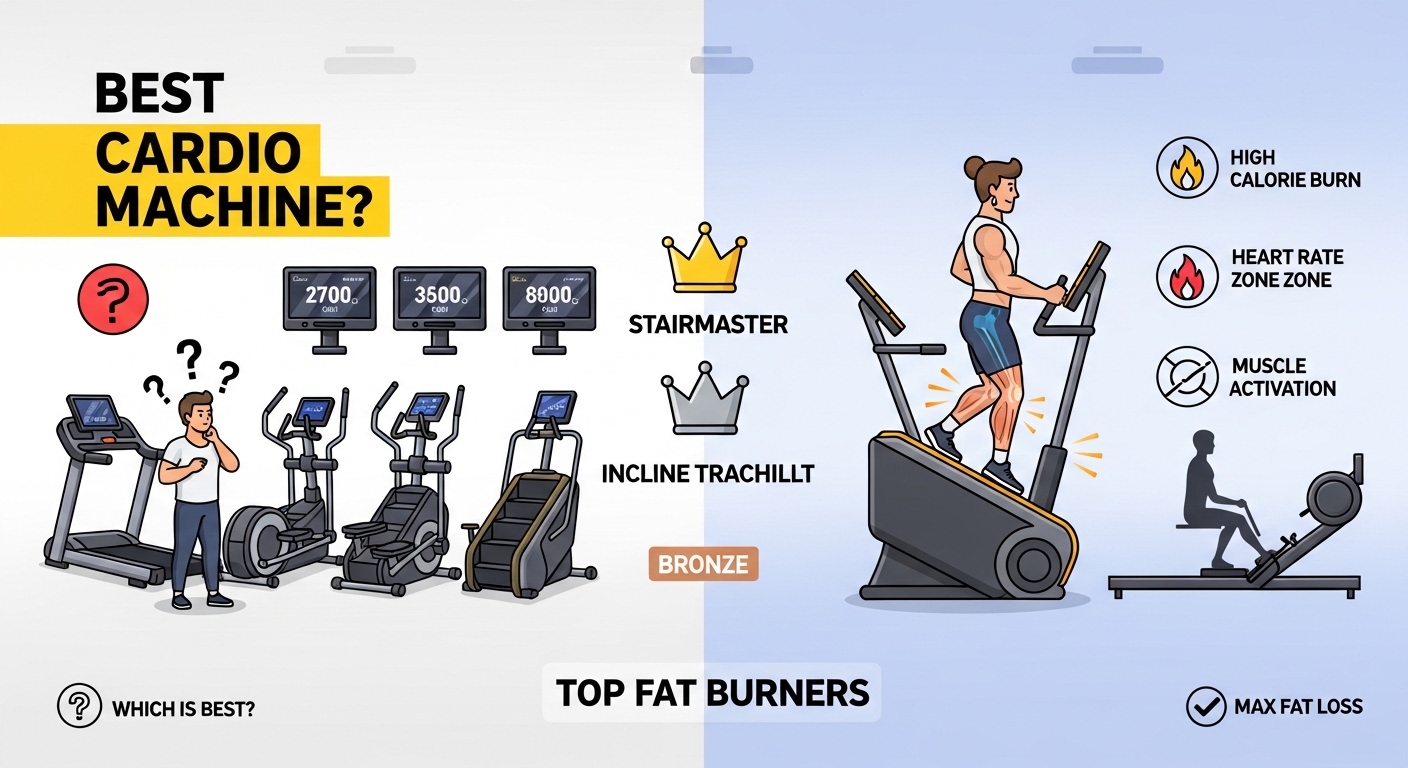

You stand in the cardio section of the gym, staring at a sea of plastic and screens. The Treadmill says you burned 400 calories. The Elliptical says 600. The Stairmaster looks like a torture device.
Which one is actually “best” for fat loss? The truth is that the machine doesn’t burn fat; your body does. The machine is just a tool to help you reach a specific heart rate. However, some tools are objectively more efficient than others. Here is the no-BS ranking of the best cardio machines based on metabolic demand.
1. The King: The Stairmaster (Step Mill)
If efficiency is your goal, the Stairmaster is the undisputed champion.
- The Logic: It forces you to lift your entire body weight against gravity with every single step. This involves the largest muscle groups in the body (glutes, quads, and hamstrings).
- The Bonus: Because it is essentially a “functional” movement, it keeps your heart rate high with a relatively slow pace.
- The Verdict: Highest calorie burn per minute, but the highest “misery” factor.
2. The Specialist: The Incline Treadmill
Running is great, but Incline Walking is the “cheat code” for fat loss.
- The Logic: By setting a treadmill to a high incline ($10-15\%$) and a moderate walking pace ($3.0-3.5$ mph), you create a massive metabolic demand without the joint impact of running.
- The Advantage: It allows you to maintain a “Zone 2” heart rate (where fat oxidation is high) for a long duration without the “eccentric” muscle damage that interferes with your weightlifting.
3. The Powerhouse: The Rowing Machine
The rower is one of the few machines that provides a true full-body workout.
- The Logic: It uses roughly 86% of your muscles. You are pushing with your legs, stabilizing with your core, and pulling with your back and arms.
- The Warning: Form is everything here. If your technique is poor, you won’t burn many calories and you’ll likely hurt your lower back. If your form is great, it’s a calorie-torching machine.
4. The “Steady” Choice: The Elliptical & Stationary Bike
These are often unfairly hated in the fitness world.
- The Logic: They are low-impact and “easy.”
- The Reality: Because they are easy, people tend to “coast” on them. If you keep the resistance high and your heart rate up, they burn calories just as well as anything else.
- The Verdict: Best for recovery days or for individuals with joint pain.
Cardio Machine Comparison Table
| Machine | Calorie Potential | Impact Level | Muscle Engagement |
| Stairmaster | Highest | Moderate | Lower Body / Glutes |
| Incline Treadmill | High | Low | Posterior Chain |
| Rower | High | Low | Full Body |
| Air Bike (Assault) | Extremely High | Low | Full Body (Sprints) |
| Elliptical | Moderate | Lowest | Full Body (Light) |
5. The “Best” Machine is the One You Use
The most efficient machine in the world is useless if you hate it so much that you stop going to the gym.
- The Sustainability Rule: If the Stairmaster makes you want to quit fitness forever, but you actually enjoy the Elliptical while watching a show, choose the Elliptical. * The Math: 45 minutes of “moderate” cardio you actually do is better than 5 minutes of “high-intensity” cardio that you quit.
The Bottom Line
For pure fat-loss efficiency, the Stairmaster and Incline Walking are the winners. They provide the most “bang for your buck” while being relatively easy on the joints.
Scientific Evidence & PubMed Studies
- Machine Comparison for Energy Expenditure: This study compared various cardio machines and found that the treadmill (specifically at an incline/run) and rowing ergometer resulted in the highest rates of energy expenditure compared to cycling or stepping.
- Incline Walking vs. Running: Research shows that incline walking at a slower pace can elicit the same metabolic intensity as running on a flat surface but with significantly reduced ground reaction forces (less joint pain).
- Full Body Recruitment: A study on rowing highlights its ability to engage multiple large muscle groups simultaneously, leading to high cardiovascular demand.